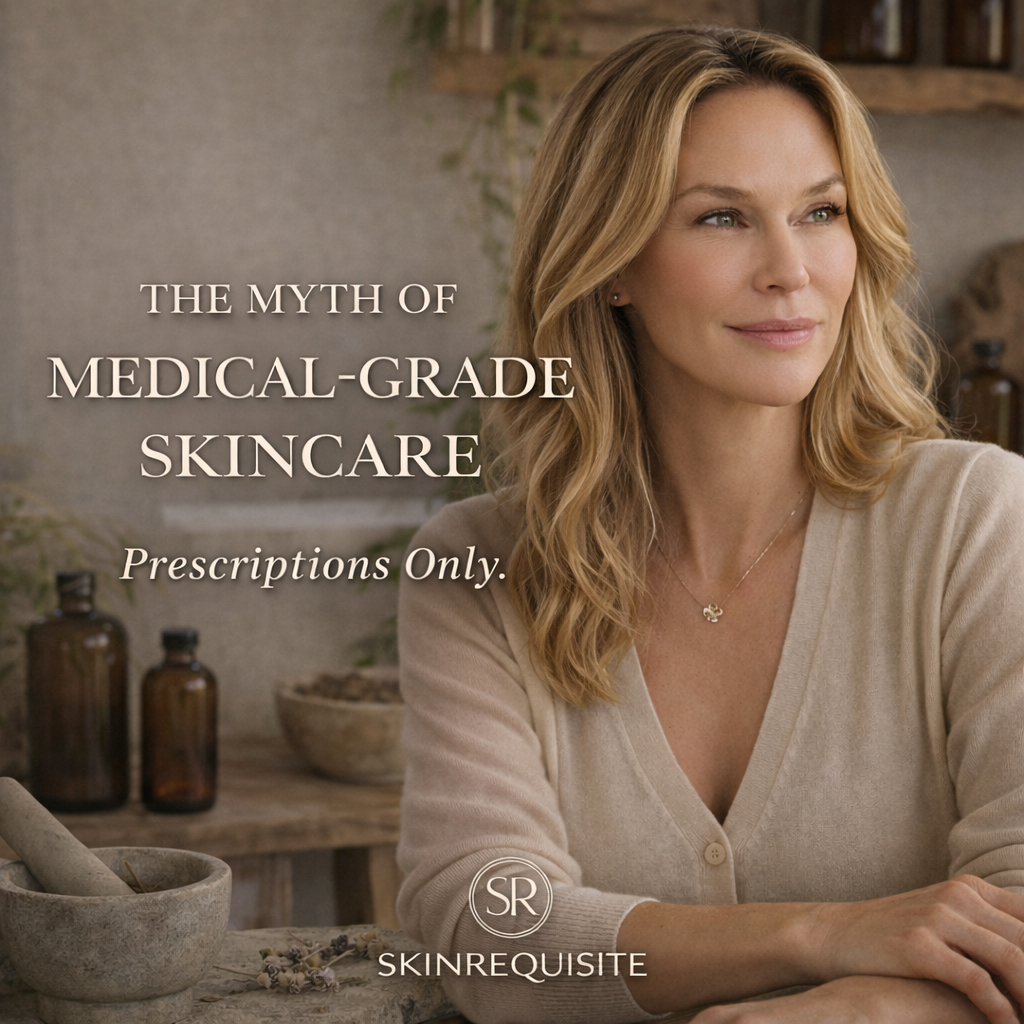
Medical-Grade Skincare Is Mostly Marketing — Unless It’s a Prescription
Walk into almost any dermatology office, med spa, or aesthetic clinic and you’ll hear the phrase:
“medical-grade skincare.”
It sounds scientific.
Clinical.
More effective.
But here’s the reality most consumers are never told:
Unless a product requires a prescription, it is not medical-grade.
It is legally considered a cosmetic.
That doesn’t mean the product is ineffective.
But it does mean the label itself does not guarantee superior performance.
And in many cases, it’s simply marketing.
What “Medical-Grade” Skincare Actually Means (Legally)
In the United States, skincare products fall into only two categories:
Cosmetics — products that improve appearance
Drugs — products that treat or alter physiological function
There is no official category called:
-
Medical grade
-
Clinical grade
-
Professional grade
These are marketing terms — not regulatory classifications.
Only prescription products — such as retinoids or certain pigmentation treatments — are regulated as drugs.
Everything else is a cosmetic.
Why the “Medical-Grade” Label Became Popular
The term became popular as aesthetic clinics began selling skincare alongside procedures.
It created a perception of:
-
Higher potency
-
Better results
-
Professional credibility
-
Scientific superiority
But the truth is simpler:
Performance comes from formulation — not branding.
And this is exactly why many people struggle with persistent skin issues despite using expensive clinic products.
Often, the real problem is not the product.
It’s the skin barrier.
You can read more about this in:
→ Why Your Moisturizer Isn’t Working (Barrier Damage Explained)
→ Before Choosing Actives, Your Skin Needs Stability First — Then Correction
These foundational concepts determine whether any skincare — medical or cosmetic — will work.
The Real Determinant of Results: Skin Barrier Health
When the skin barrier is compromised, everything changes.
You may notice:
-
Persistent dryness
-
Redness
-
Sensitivity
-
Breakouts
-
Uneven tone
-
Premature aging
This process is driven by chronic inflammation — often called:
inflammaging
You can explore this deeper here:
→ Free Radical Damage: How Your Skin Ages Faster Than It Should
→ Why Your Glow Is Fading
Because once inflammation becomes chronic, skin cannot repair properly — no matter how expensive the products are.
Most “Medical-Grade” Products Use the Same Ingredients
There is no secret ingredient exclusive to clinics.
Most skincare — regardless of price — uses the same core actives:
-
Vitamin C
-
Niacinamide
-
Retinol
-
Peptides
-
Hyaluronic acid
-
Antioxidants
What determines effectiveness is not the ingredient name — but:
-
Concentration
-
Stability
-
Delivery system
-
Skin compatibility
-
Barrier support
This is why properly formulated antioxidant products can significantly improve skin resilience.
For example:
→ The Truth About Antioxidants in Skincare
→ Collagen & Skin Aging: The Structural Foundation of Youthful Skin
These articles explain how skin aging is driven more by oxidative stress and inflammation than by product labels.
Why Expensive Doesn’t Always Mean Better
Price often reflects:
-
Branding
-
Distribution model
-
Clinic markup
-
Packaging
-
Sales commissions
Not necessarily formulation quality.
In fact, many high-priced clinic products contain:
-
Fillers
-
Fragrance
-
Thickening agents
-
Low active concentrations
Meanwhile, well-designed formulations focus on:
-
Fewer ingredients
-
Higher functional concentrations
-
Low irritation potential
-
Barrier compatibility
This is especially important for sensitive or reactive skin.
If this sounds familiar, read:
→ Most People Who Think They Have Sensitive Skin Actually Have Damaged Skin
Because sensitivity is often a symptom of barrier dysfunction — not a skin type.
The Only True “Medical-Grade” Skincare Is Prescription
When a product truly alters skin physiology, it must be regulated as a drug.
Examples include:
-
Prescription retinoids
-
Prescription antibiotics
-
Prescription depigmenting agents
These require medical supervision because they can:
-
Change cellular behavior
-
Cause side effects
-
Require controlled dosing
That level of regulation is what defines true medical treatment.
Everything else is cosmetic — regardless of where it is sold.
What To Look For Instead of “Medical-Grade”
If you want real results, focus on formulation fundamentals.
Look for products that:
Support the skin barrier
Reduce inflammation
Provide antioxidant protection
Use effective ingredient concentrations
Maintain stability and compatibility
Avoid relying on:
Buzzwords
Price
Clinic branding
Marketing claims
Because skin health is built through consistency — not labels.
A Smarter Approach to Skin Health
Instead of asking:
“Is this medical-grade?”
Ask:
-
Does this support the skin barrier?
-
Does this reduce inflammation?
-
Is the formula stable?
-
Are the concentrations appropriate?
These questions lead to better outcomes.
And they prevent the most common mistake in skincare:
Using stronger actives before the skin is stable.
You can explore this principle further here:
→ Your Skin Routine Might Be Aging You Faster
→ The Real Reason Your Skin Isn’t Glowing
Both explain why skin health must come before correction.
The Bottom Line
“Medical-grade skincare” is mostly a marketing term.
Unless a product requires a prescription, it is legally a cosmetic.
What determines results is not the label —
it is the formulation.
And most importantly:
Healthy skin begins with barrier stability.

Written by Kamila Starczewska

Leave a comment
This site is protected by hCaptcha and the hCaptcha Privacy Policy and Terms of Service apply.