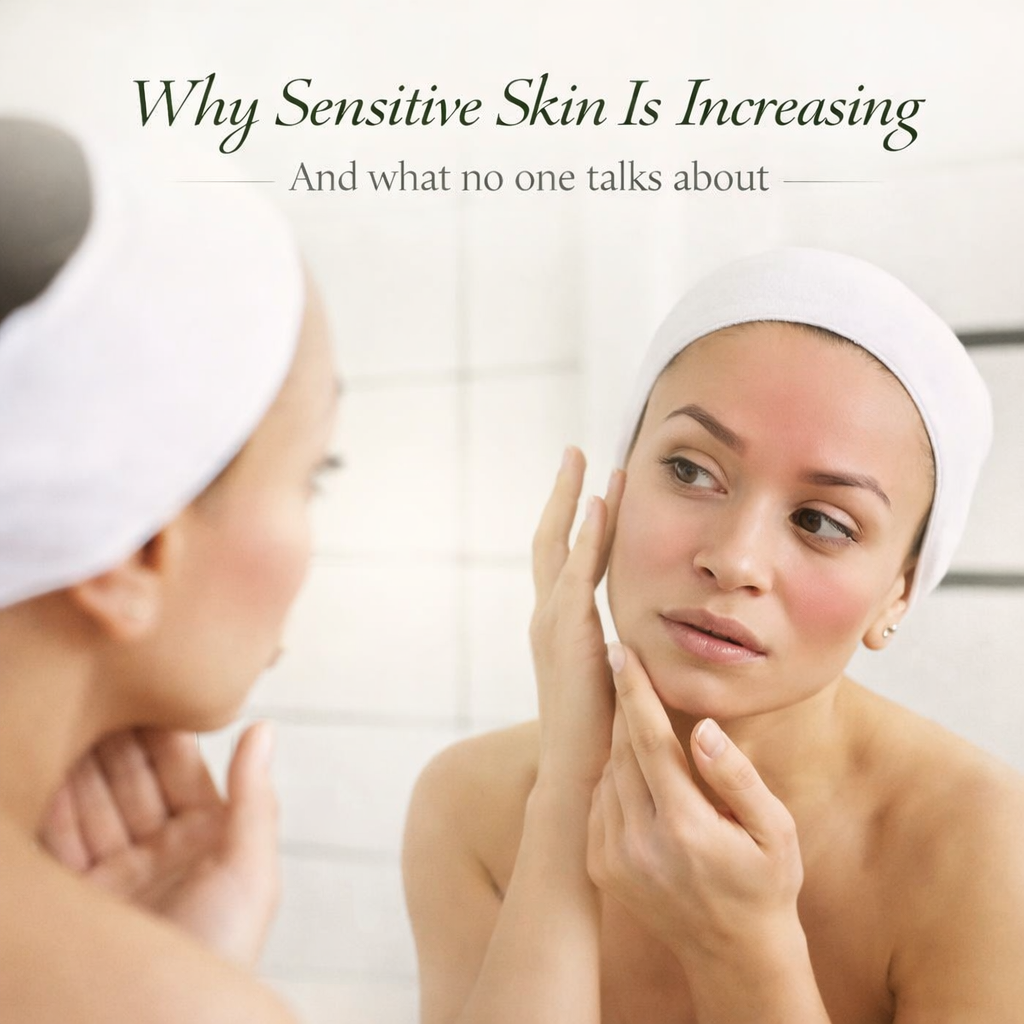
Why Sensitive Skin Is Increasing (And What No One Talks About)
Sensitive skin used to be the exception.
Today, it’s becoming the norm.
More people than ever describe their skin as reactive, stinging, burning, tight, flushed, or unpredictable—even those who never struggled before. What’s striking is that this rise in sensitivity isn’t limited to people with eczema, rosacea, or allergies. It’s happening to otherwise “normal” skin.
And the most uncomfortable truth?
Much of it is man-made.
Let’s talk about what’s actually driving the sensitive skin epidemic—and the parts the beauty industry rarely addresses.
1. Overexposure to “Actives” Is Breaking the Skin Barrier
We’ve been taught that skincare should do something:
tingle, tighten, exfoliate, resurface, peel.
Vitamin C every morning.
Retinoids every night.
Acids layered on top.
Exfoliation labeled as “gentle”—used daily.
The result? Chronic micro-inflammation.
Your skin barrier isn’t designed to be constantly challenged. When actives are stacked, rushed, or used without adequate recovery time, the barrier weakens. Water loss increases. Nerve endings become exposed. Suddenly, products that once felt fine start to burn.
This isn’t sensitivity from birth—it’s sensitivity created over time.
2. The Skin Microbiome Is Being Stripped Away
Healthy skin relies on a delicate ecosystem of beneficial bacteria. This microbiome plays a critical role in immune defense, inflammation control, and barrier resilience.
But many modern routines unintentionally wipe it out:
-
Harsh cleansers
-
Daily exfoliating acids
-
Alcohol-heavy toners
-
Over-cleansing (especially morning + night)
When the microbiome is disrupted, the skin becomes reactive, less tolerant, and slower to heal. Redness, breakouts, and irritation follow.
What’s rarely discussed is that “clean” doesn’t always mean healthy when it comes to skin.
3. Stress Is Showing Up on the Skin—Literally
Skin is not separate from the nervous system.
It is part of it.
Chronic stress elevates cortisol, which:
-
Impairs barrier repair
-
Increases inflammation
-
Reduces lipid production
-
Delays healing
This is why stressed skin flushes more easily, reacts faster, and struggles to recover—even with “good” products.
No serum can fully override a nervous system stuck in fight-or-flight. Yet stress is almost never addressed in skincare conversations.
4. “Anti-Aging” Messaging Encourages Over-Treatment
The fear of aging has pushed people toward aggressive routines far earlier than necessary.
Twenty-somethings using strong retinoids daily.
Teenagers exfoliating with acids.
Everyone chasing poreless, glass-like skin.
But skin health isn’t built through constant correction—it’s built through support.
When skin is pushed to perform instead of allowed to function, sensitivity becomes inevitable.
5. Fast Results Are Prioritized Over Long-Term Skin Health
Many products are formulated to deliver immediate visual changes:
-
Tightness
-
Shine
-
Redness reduction (via vasoconstriction)
These short-term effects can mask deeper damage. Skin may look improved while its barrier is quietly deteriorating underneath.
True skin health doesn’t always show up overnight—but it lasts.
What Sensitive Skin Really Needs (But Rarely Gets)
Sensitive skin isn’t weak.
It’s overstimulated.
The solution isn’t more actives—it’s fewer, better-chosen ones.
Not constant exfoliation—but repair.
Not forcing change—but restoring balance.
Healthy skin should feel:
-
Calm
-
Comfortable
-
Resilient
-
Predictable
When the barrier is supported, sensitivity often fades—because it was never a permanent condition to begin with.
A Different Approach to Skin Health
At SkinRequisite, we believe sensitivity is often a signal—not a flaw.
A signal that the skin needs:
-
Barrier repair
-
Anti-inflammatory support
-
Intelligent formulation
-
Time to recover
Skin doesn’t need to be pushed to perform.
It needs to be allowed to function as designed.

Written by Kamila Starczewska

Leave a comment
This site is protected by hCaptcha and the hCaptcha Privacy Policy and Terms of Service apply.