Article: NAD⁺ in Skincare: Does It Really Belong in a Formula?
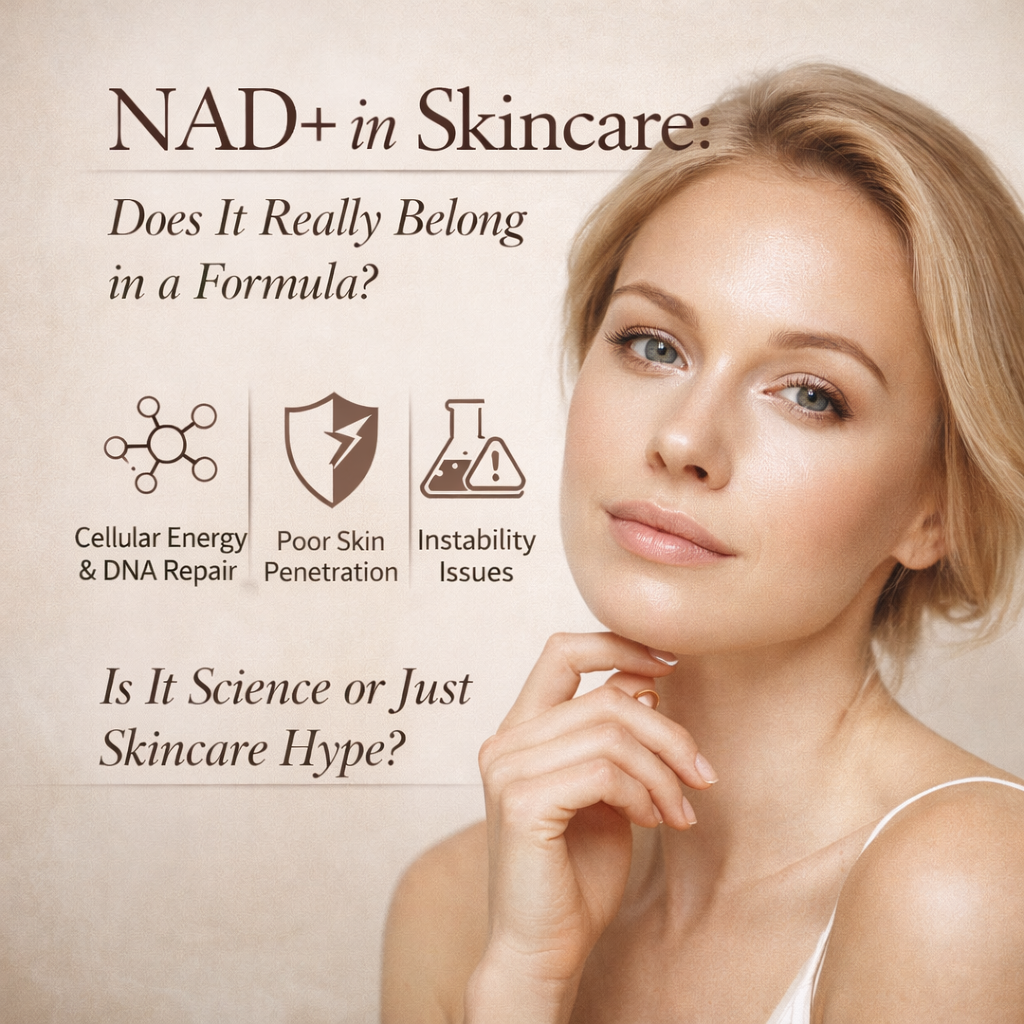
NAD⁺ in Skincare: Does It Really Belong in a Formula?
NAD⁺ has become one of the most talked-about molecules in longevity science. From cellular energy to DNA repair, it’s often described as a cornerstone of healthy aging — so it’s no surprise that NAD⁺ has started appearing in skincare.
But at SkinRequisite, we don’t follow ingredients just because they’re trending.
We ask a more important question:
Does this ingredient actually work topically — and does it respect skin physiology?
Let’s take an honest look.
What NAD⁺ Does in the Body
NAD⁺ (nicotinamide adenine dinucleotide) is a coenzyme found in every living cell. It plays a critical role in:
-
Cellular energy production (mitochondria)
-
DNA repair
-
Cellular stress resistance
-
Longevity signaling pathways (including sirtuins)
As we age, intracellular NAD⁺ levels decline, which is why NAD⁺ supplementation has gained so much attention in internal medicine and longevity research.
So the idea of adding NAD⁺ to skincare sounds compelling — but skin biology is very different from systemic biology.
The Topical Reality of NAD⁺
Here’s the part most brands skip.
NAD⁺ is:
-
A large, highly polar molecule
-
Water-soluble and unstable
-
Poorly penetrating through intact skin
Even when delivered in advanced formats (like liposomes), topical NAD⁺:
-
Primarily remains in the upper layers of the skin
-
Does not reliably enter skin cells intact
-
Does not consistently raise intracellular NAD⁺ levels
In other words, topical NAD⁺ cannot perform its most famous functions, because those functions require it to be insidethe cell.
That doesn’t mean it’s useless — but it does mean its role must be framed honestly.
What Topical NAD⁺ Can Do
When properly stabilized and formulated, NAD⁺ may offer:
-
Local antioxidant support
-
Redox balance at the epidermal level
-
A supportive environment for repair signaling
-
Benefits for compromised or post-procedure skin
These effects are surface-to-epidermal, not deep cellular rejuvenation.
This distinction matters.
Why Stability Is a Serious Challenge
To even keep NAD⁺ intact in a cosmetic formula, you need:
-
Neutral pH (5.5–6.5)
-
Encapsulation or protective delivery systems
-
Strong oxidation control
-
Airless, opaque packaging
-
Limited compatibility with other actives
Even then, shelf stability can be unpredictable.
This raises a critical formulation question:
Is the cost, complexity, and limitation justified by the benefit?
The Ingredient That Actually Supports NAD⁺ in Skin
If the goal is to support NAD⁺ inside skin cells, there’s a much more effective option:
Niacinamide (Vitamin B3).
Niacinamide:
-
Penetrates skin easily
-
Is extremely stable
-
Has decades of clinical support
-
Increases intracellular NAD⁺ production
-
Strengthens the barrier
-
Reduces inflammation
-
Improves tone, texture, and resilience
This is why niacinamide remains one of the most biologically meaningful longevity ingredients in topical skincare.
Our Formulation Philosophy at SkinRequisite
We believe skincare should:
-
Work with skin physiology
-
Deliver benefits where they actually occur
-
Avoid overclaims and ingredient theater
-
Prioritize barrier health and repair signaling
That’s why we focus on:
-
NAD⁺ pathway support, not surface buzzwords
-
Ingredients that demonstrably improve cellular function
-
Regenerative signaling (not forced stimulation)
In advanced repair formulas, we pair:
-
GHK-Cu for repair communication
-
Niacinamide for NAD⁺ synthesis support
-
Barrier lipids and calming antioxidants for resilience
When NAD⁺ is used, it is secondary, supportive, and positioned with honesty — never as a miracle ingredient.
So, Does NAD⁺ Belong in Skincare?
The answer isn’t a simple yes or no.
NAD⁺ does not belong as a hero ingredient in topical skincare if the goal is cellular energy renewal or DNA repair inside skin cells.
However, it may have a place as a supportive ingredient in:
-
Repair-focused
-
Barrier-first
-
Post-procedure
-
Longevity-inspired formulations
— when paired with ingredients that actually do the heavy lifting.
The SkinRequisite Standard
At SkinRequisite, every ingredient must earn its place.
We don’t formulate for trends.
We formulate for function, integrity, and long-term skin health.
Because true skin longevity isn’t about what sounds impressive —
it’s about what works.

Written by Kamila Starczewska

Leave a comment
This site is protected by hCaptcha and the hCaptcha Privacy Policy and Terms of Service apply.