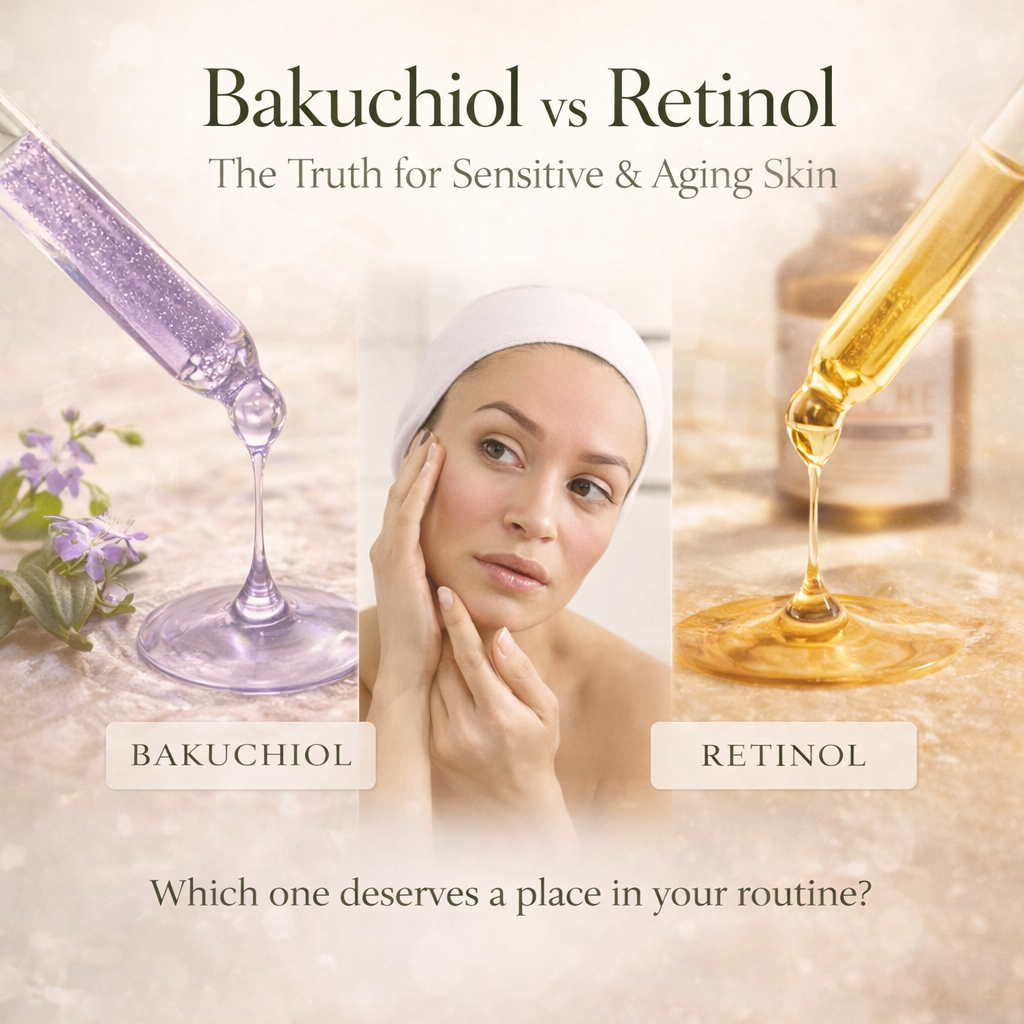
Bakuchiol vs Retinol
The Truth for Sensitive & Aging Skin
Few skincare ingredients have been praised—and feared—as much as retinol. For decades it’s been positioned as the gold standard for anti-aging. Then bakuchiol entered the conversation, often marketed as a “natural retinol alternative.”
But here’s the truth most brands gloss over: they are not interchangeable, and for sensitive or compromised skin, the difference matters more than marketing suggests.
Let’s break it down—calmly, honestly, and with skin health first.
What Retinol Really Does (and Why It’s So Reactive)
Retinol is a vitamin A derivative that accelerates cell turnover and stimulates collagen production. That’s the upside.
The downside?
It works by intentionally stressing the skin to trigger renewal.
Common side effects include:
-
Redness, peeling, and burning
-
Barrier disruption and increased TEWL
-
Heightened sun sensitivity
-
Long adjustment periods (“retinization”)
For resilient skin, this trade-off can be manageable.
For sensitive, reactive, rosacea-prone, post-procedure, or over-exfoliated skin, it often isn’t.
Retinol doesn’t distinguish between “needs renewal” and “needs repair.”
What Bakuchiol Actually Is (Not Just a Trend)
Bakuchiol is a bioactive compound derived from the Psoralea corylifolia plant. While structurally different from retinoids, studies show it can activate similar gene pathways involved in collagen synthesis, elasticity, and pigmentation regulation—without triggering the same inflammatory cascade.
What that means in real skin terms:
-
Improved fine lines and texture
-
Increased firmness and elasticity
-
More even tone
-
No peeling, burning, or forced adaptation phase
Bakuchiol works with the skin—not against it.
The Real Difference Isn’t Results — It’s the Cost to the Barrier
This is the part most comparisons leave out.
Retinol:
-
Forces rapid change
-
Temporarily weakens the barrier
-
Requires strict buffering, cycling, and recovery
-
Often incompatible with acids, vitamin C, or compromised skin
Bakuchiol:
-
Supports gradual renewal
-
Preserves barrier integrity
-
Plays well with sensitive routines
-
Can be used daily, even long-term
Aging skin doesn’t just need stimulation—it needs resilience.
Sensitive Skin Doesn’t Need “Stronger” — It Needs Smarter
Many people assume sensitivity means they’re “missing out” on anti-aging results.
In reality, chronically inflamed skin ages faster.
Fine lines deepen when the barrier is impaired.
Pigmentation worsens with inflammation.
Collagen breaks down under stress.
For sensitive and aging skin, progress comes from:
-
Lower inflammation
-
Consistent barrier support
-
Ingredients that don’t demand recovery afterward
Bakuchiol fits this physiology. Retinol often doesn’t.
When Retinol Can Make Sense
Retinol isn’t inherently bad—it’s just context-dependent.
It may be appropriate if:
-
Your skin barrier is strong and tolerant
-
You’re under professional guidance
-
You’re willing to accept downtime and strict sun avoidance
Even then, it shouldn’t be used indefinitely or aggressively.
Who Bakuchiol Is Best For
Bakuchiol is especially well-suited for:
-
Sensitive or reactive skin
-
Barrier-impaired skin
-
Rosacea-prone skin
-
Post-procedure recovery
-
First signs of aging
-
Long-term anti-aging without inflammation
It’s not about choosing the “gentler” option—it’s about choosing the more sustainable one.
The Takeaway
Retinol pushes skin to change.
Bakuchiol allows skin to heal, strengthen, and renew simultaneously.
For sensitive and aging skin, the goal isn’t shock therapy—it’s longevity.
Healthy skin doesn’t need to be forced into youth.
It needs to be supported into balance.

Written by Kamila Starczewska

Leave a comment
This site is protected by hCaptcha and the hCaptcha Privacy Policy and Terms of Service apply.