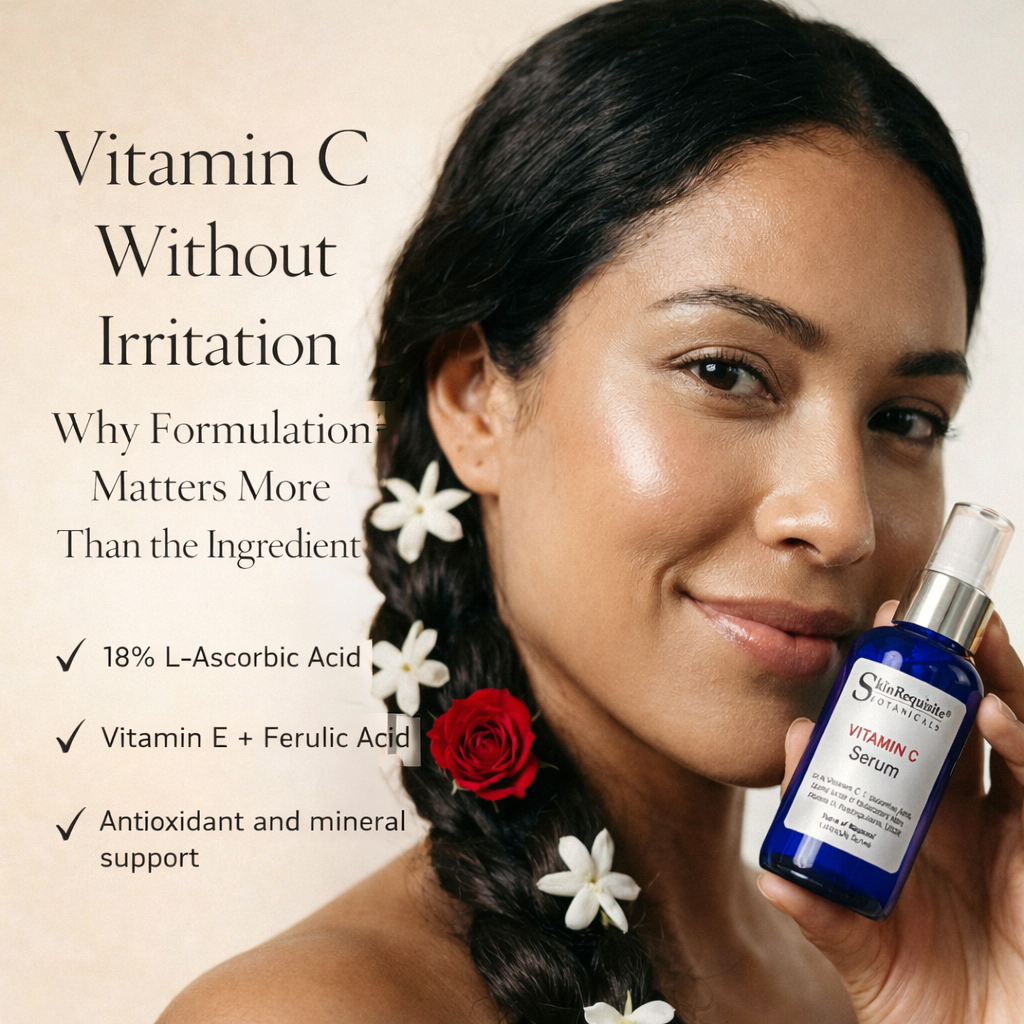
Vitamin C Without Irritation Why Formulation Matters More Than the Ingredient
Vitamin C is one of the most researched, effective ingredients in skincare — and also one of the most misunderstood.
For some, it delivers visible brightness, firmness, and resilience.
For others, it causes stinging, redness, breakouts, or sensitivity.
This has led to a common misconception:
that Vitamin C itself is the problem.
In reality, irritation is rarely about the ingredient alone.
It’s almost always about how Vitamin C is formulated, stabilized, and supported.
Not All Vitamin C Is Created Equal
SkinRequisite’s Vitamin C Serum is formulated with pure L-ascorbic acid, the gold-standard form of vitamin C shown in clinical research to be the most biologically active and effective for the skin.
Unlike vitamin C derivatives or esters — which must convert within the skin and often deliver inconsistent results — L-ascorbic acid works directly at the cellular level.
That potency is exactly why formulation matters.
High-performance vitamin C is not forgiving of poor design.
What Actually Causes Vitamin C Irritation
Vitamin C irritation is usually the result of one or more of the following:
-
Poor stabilization
-
Extremely low pH without buffering
-
High concentration without antioxidant or mineral support
-
Lack of barrier-supportive cofactors
-
Daily use on compromised or inflamed skin
When L-ascorbic acid is left unsupported, it can overwhelm the skin — even when the percentage looks “normal” on paper.
The skin doesn’t react to numbers.
It reacts to stress load.
What to Look for in a True Vitamin C Serum
A clinically effective vitamin C formula should include more than vitamin C itself.
✔ L-Ascorbic Acid (10–20%)
✔ Vitamin E + Ferulic Acid for stability and synergy
✔ Air-tight, light-protected packaging
✔ Antioxidant and mineral cofactors to support tolerance
Without this ecosystem, vitamin C becomes unstable, irritating, or ineffective long before it benefits the skin.
Why SkinRequisite’s Vitamin C Is Different
This formula was designed to deliver results without unnecessary inflammation.
Not by weakening vitamin C — but by supporting it intelligently.
Vitamin C (L-Ascorbic Acid – 18%)
L-ascorbic acid is the most effective form of vitamin C for:
-
Supporting collagen production
-
Improving the appearance of uneven tone
-
Defending against oxidative stress from UV exposure and pollution
Our 18% concentration is chosen for clinical performance, not shock value.
Ferulic Acid + Vitamin E
This clinically recognized antioxidant pairing:
-
Enhances vitamin C stability
-
Increases overall antioxidant efficacy
-
Provides additional protection against environmental damage
This combination is essential for both performance and skin comfort.
Glutathione
A powerful antioxidant that supports:
-
Skin brightness
-
Smoothness
-
Clarity
-
Protection against oxidative aging
Glutathione also helps modulate oxidative stress, improving overall skin tolerance to active ingredients.
Vitamin A (Beta-Carotene & Retinyl Palmitate)
Included in supportive, non-aggressive forms to:
-
Encourage gentle renewal
-
Support smoothness and refinement
-
Complement antioxidant activity
This is not stimulation for stimulation’s sake — it’s measured support.
Mineral & Skin-Support Complex
Zinc, calcium, magnesium, glucosamine, and MSM work together to:
-
Support barrier function
-
Reduce inflammation
-
Improve resilience and recovery
-
Maintain hydration balance
This mineral matrix plays a critical role in buffering activity and supporting long-term skin health.
Witch Hazel Hydrosol
Used for its anti-inflammatory and balancing properties, not as a harsh astringent. It helps regulate skin response while maintaining comfort and clarity.
Why Irritation Isn’t Inevitable
Vitamin C does not need to burn, sting, or tingle to be effective.
Those sensations are not proof of efficacy — they’re signs of imbalance.
When vitamin C is:
-
Properly stabilized
-
Supported by antioxidant partners
-
Buffered with minerals and skin-supportive ingredients
-
Packaged to preserve potency
It can be powerful, effective, and well-tolerated — even at clinically meaningful concentrations.
Who Should Still Use Vitamin C Thoughtfully
Even the best formulation should be used strategically if you have:
-
Active barrier damage
-
Rosacea or flushing
-
Over-exfoliated skin
-
High baseline inflammation
In these cases, barrier repair should come first — not because vitamin C is harmful, but because timing matters.
Skin health is contextual.
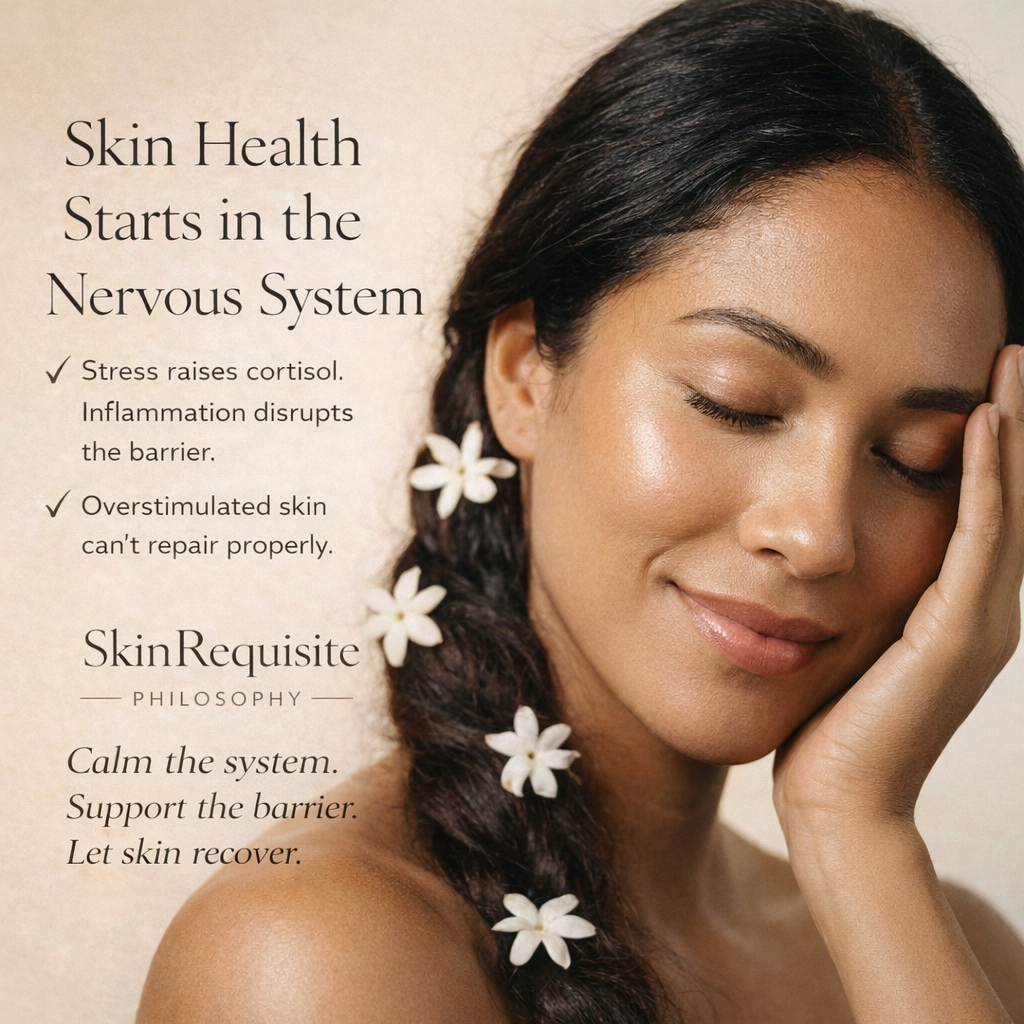
The SkinRequisite Philosophy
We don’t believe in aggressive correction.
We believe in:
-
Reducing inflammation
-
Supporting skin physiology
-
Using active ingredients with intention
-
Choosing long-term resilience over short-term reaction
Vitamin C should strengthen the skin — not challenge it.
The Takeaway
Vitamin C isn’t the problem.
Poor formulation is.
When L-ascorbic acid is supported by antioxidant synergy, mineral cofactors, and barrier-aware design, it becomes one of the most powerful tools in skincare — without unnecessary irritation.
Healthy skin doesn’t need to be forced into brightness.
It needs to be protected, supported, and allowed to function optimally.
Glow follows balance.

Written by Kamila Starczewska

Leave a comment
This site is protected by hCaptcha and the hCaptcha Privacy Policy and Terms of Service apply.