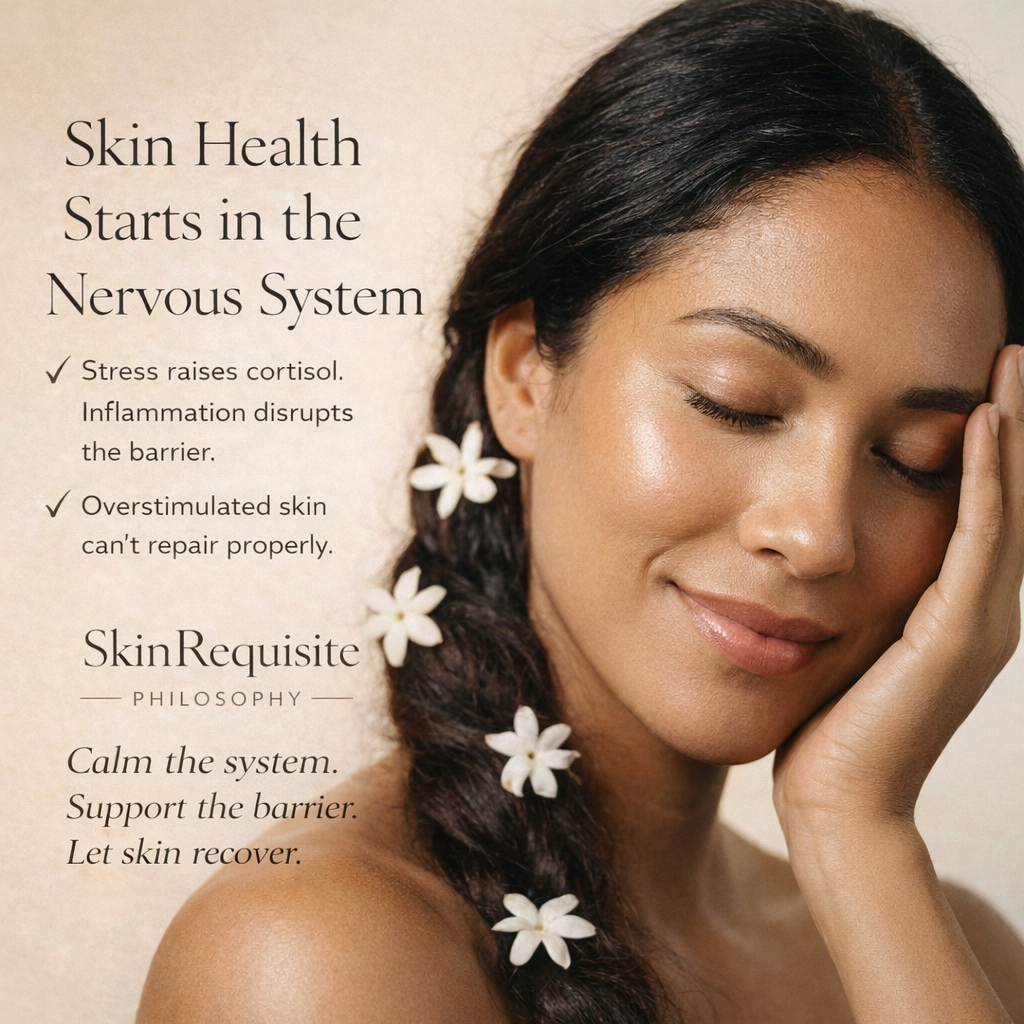
Skin Health Starts in the Nervous System
Stress, Cortisol, Inflammation, and the Skin Barrier
We often treat skin as if it exists in isolation — something that can be corrected with the right serum, exfoliant, or active ingredient.
But skin doesn’t operate independently.
It listens. Constantly.
To hormones.
To inflammation.
To stress signals coming from the nervous system.
And when those signals are overwhelming, skin responds accordingly.
The Skin–Brain Connection Is Real
Skin and the nervous system share the same embryological origin. They are biologically connected, communicating through neurotransmitters, hormones, and inflammatory mediators.
This means that what happens internally — emotionally, hormonally, physiologically — directly influences how skin behaves on the surface.
When the nervous system is calm, skin tends to be resilient, balanced, and responsive.
When the nervous system is overstimulated, skin shifts into defense mode.
How Stress Translates Into Skin Issues
Chronic stress elevates cortisol, the body’s primary stress hormone.
While cortisol is essential for survival, prolonged elevation has consequences — especially for skin.
High cortisol levels:
-
Increase systemic inflammation
-
Suppress lipid production in the skin
-
Slow wound healing and repair
-
Impair collagen synthesis
-
Disrupt the skin barrier
Over time, this creates the perfect environment for skin dysfunction.
Cortisol and the Skin Barrier
The skin barrier is responsible for:
-
Retaining moisture
-
Protecting against environmental aggressors
-
Regulating inflammation
-
Maintaining tolerance to products
Cortisol directly interferes with this process.
As cortisol rises:
-
Ceramide production decreases
-
Transepidermal water loss increases
-
Skin becomes thinner and more permeable
-
Nerve endings become more exposed
This is why stressed skin often feels:
-
Tight
-
Sensitive
-
Reactive
-
Easily irritated
-
Suddenly “intolerant” to products that once worked
The issue isn’t that the skin became weak — it became overstimulated.
Inflammation: The Silent Accelerator of Aging
Inflammation is one of the most underestimated drivers of visible aging.
Chronic, low-grade inflammation:
-
Breaks down collagen
-
Delays cellular repair
-
Worsens pigmentation
-
Triggers redness and flushing
-
Increases sensitivity
This process, often referred to as inflammaging, explains why skin can appear to age rapidly during periods of stress, illness, hormonal transition, or emotional strain.
No amount of aggressive “anti-aging” can override this state.
Why Overstimulated Skin Can’t Heal
When the nervous system is constantly activated, skin remains in survival mode.
In this state:
-
Repair is deprioritized
-
Barrier recovery slows
-
Tolerance drops
-
Inflammation remains elevated
This is why overstressed skin often reacts poorly to:
-
Strong actives
-
Frequent exfoliation
-
High-intensity treatments
-
Constant product changes
The skin isn’t resisting care — it’s conserving energy.
Calm Is a Biological Requirement, Not a Luxury
Healthy skin requires periods of physiological calm to repair, regenerate, and strengthen itself.
This doesn’t mean doing nothing.
It means doing the right things.
Skin thrives when:
-
Inflammatory pathways are quieted
-
The barrier is supported with lipids and minerals
-
Antioxidants protect rather than irritate
-
Formulations work with skin biology
Calm is not passive.
It is active repair.
The SkinRequisite Philosophy
At SkinRequisite, we approach skin health through a wider lens.
We don’t ask:
“How quickly can this product change the skin?”
We ask:
“How does this support the skin’s ability to function long-term?”
Our formulations are designed to:
-
Reduce inflammation
-
Support barrier integrity
-
Respect nervous system signaling
-
Strengthen skin resilience over time
Because pushing skin harder doesn’t make it healthier.
Supporting it does.
A Different Way to Think About Skin Care
If your skin feels unpredictable, reactive, or suddenly difficult to manage, it may not need stronger products.
It may need:
-
Less stimulation
-
More support
-
Fewer variables
-
Time to recover
Skin that feels safe behaves better.
The Takeaway
Skin health doesn’t start at the surface.
It starts deeper — in the nervous system, the barrier, and the body’s ability to regulate inflammation.
When stress is addressed, inflammation calms.
When inflammation calms, the barrier strengthens.
When the barrier strengthens, skin becomes resilient again.
Healthy skin isn’t forced.
It’s supported.
Final Thought
Calm skin is not unambitious skin.
It’s skin that’s been given the conditions to thrive.
And that’s where real skin health begins.

Written by Kamila Starczewska



Leave a comment
This site is protected by hCaptcha and the hCaptcha Privacy Policy and Terms of Service apply.