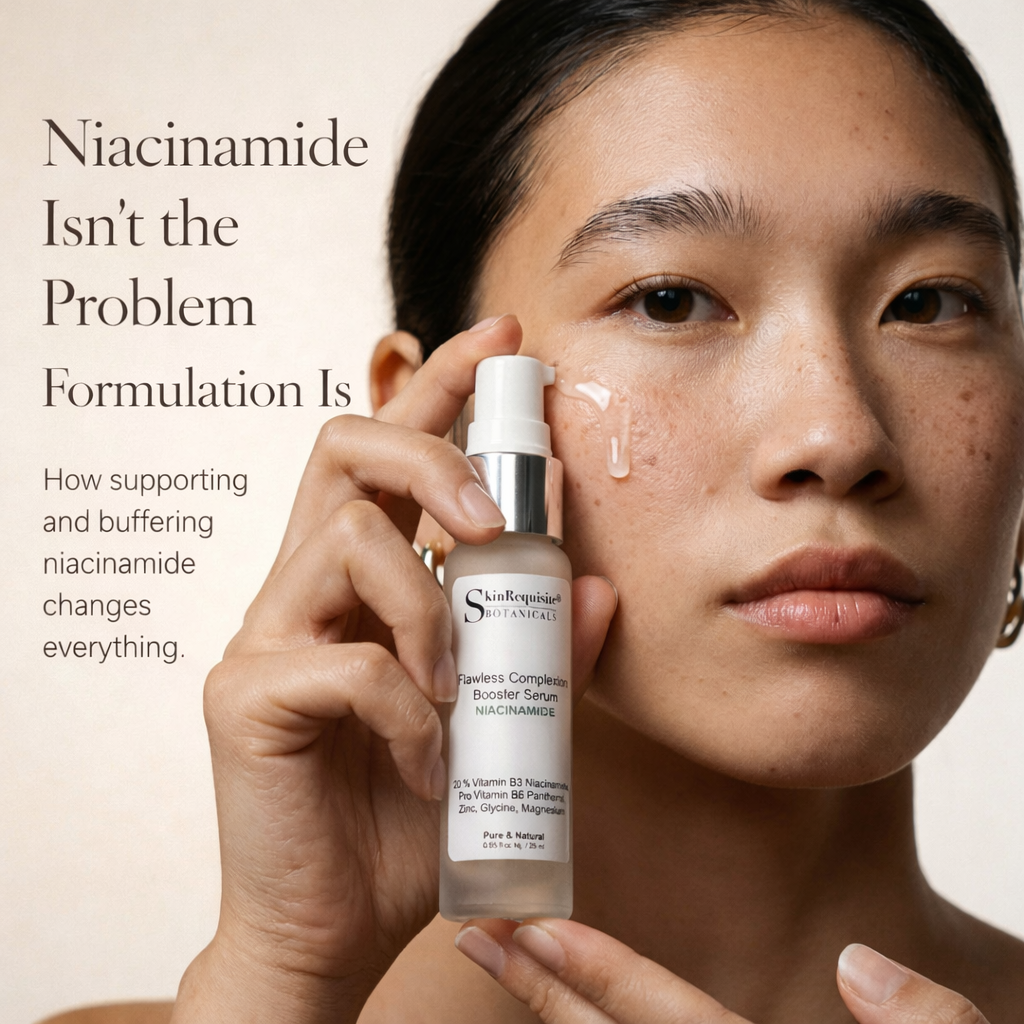
Niacinamide Isn’t the Problem Formulation Is
Niacinamide has developed a reputation problem.
Some people swear by it.
Others experience flushing, burning, redness, or breakouts and assume their skin “can’t tolerate” vitamin B3.
Both experiences can be true.
Because the real issue isn’t niacinamide itself —
it’s how it’s formulated, buffered, and supported.
Why High-Percentage Niacinamide Often Fails
Niacinamide is frequently added to formulas as a standalone hero, pushed to high percentages without regard for skin physiology.
When this happens, especially at 10% or higher, niacinamide can:
-
Increase blood flow too aggressively
-
Trigger flushing or warmth
-
Overstimulate compromised skin
-
Exacerbate inflammation
This is why many people associate high-percentage niacinamide with irritation.
But irritation is not caused by the number alone.
It’s caused by lack of modulation.
Why SkinRequisite’s 20% Niacinamide Is Different
At SkinRequisite, niacinamide is not used in isolation.
Our 20% formula was designed specifically for:
-
Hyperpigmentation
-
Active acne
-
Post-inflammatory discoloration
-
Thickened, resilient, or inflamed skin
And it works — consistently — without irritation.
The difference lies in how the skin is guided, not forced.
The Role of Synergistic Formulation
High-dose niacinamide requires counterbalance.
That’s why our formula pairs niacinamide with:
Witch Hazel
Not as an astringent, but as an anti-inflammatory botanical
→ Helps regulate redness
→ Calms vascular reactivity
→ Supports clarity without stripping
Zinc Gluconate
A critical co-factor for acne-prone and pigmented skin
→ Reduces inflammation
→ Supports oil regulation
→ Calms active breakouts
→ Enhances niacinamide’s brightening effects
Lavender (Properly Used)
Selected for its anti-inflammatory and soothing properties, not fragrance
→ Helps calm irritated skin
→ Supports healing
→ Reduces stress-induced inflammation
Together, these ingredients buffer niacinamide’s intensity while amplifying its benefits.
This is why clients see improvement — not irritation.
When High-Strength Niacinamide Makes Sense
High-percentage niacinamide is not for every skin type — and it shouldn’t be.
It performs best when:
-
Skin is acne-prone or congested
-
Hyperpigmentation is active
-
The barrier is thickened, not fragile
-
Inflammation needs regulation, not suppression
-
The formula includes calming and mineral support
Used in the right context, niacinamide becomes corrective, not disruptive.
Why Some Skin Types Still Should Be Cautious
Even with intelligent formulation, niacinamide may not be ideal for:
-
Rosacea-prone skin
-
Severely barrier-impaired skin
-
Highly vascular, flushing-prone skin
-
Early menopausal skin with low lipid reserves
This isn’t a failure — it’s individual physiology.
Skincare should be personalized, not universal.
Ingredient Percentages Don’t Tell the Whole Story
Consumers are taught to judge products by numbers:
-
Higher percentage = stronger
-
Stronger = better
But skin doesn’t respond to numbers.
It responds to balance.
A well-buffered 20% niacinamide can be more tolerable than a poorly formulated 5%.
Formulation matters more than concentration.
The SkinRequisite Philosophy
We don’t formulate for trends.
We formulate for real skin conditions.
Our niacinamide serum wasn’t created to be “gentle for everyone.”
It was created to be effective for the skin that actually needs it.
That’s why:
-
It delivers results for hyperpigmentation and acne
-
It doesn’t rely on irritation
-
It respects inflammation pathways
-
It works consistently across clients
The Takeaway
Niacinamide isn’t inherently irritating.
And high percentages aren’t inherently harmful.
What causes problems is unbalanced formulation.
When niacinamide is supported with:
-
Anti-inflammatory botanicals
-
Mineral cofactors
-
Barrier-respecting design
It becomes a powerful, well-tolerated corrective ingredient.
Skin doesn’t need weaker formulas.
It needs smarter ones.
Final Thought
At SkinRequisite, we don’t ask:
“Can we push this ingredient higher?”
We ask:
“Can the skin handle this — and benefit from it — long term?”
That’s the difference.

Written by Kamila Starczewska

Leave a comment
This site is protected by hCaptcha and the hCaptcha Privacy Policy and Terms of Service apply.