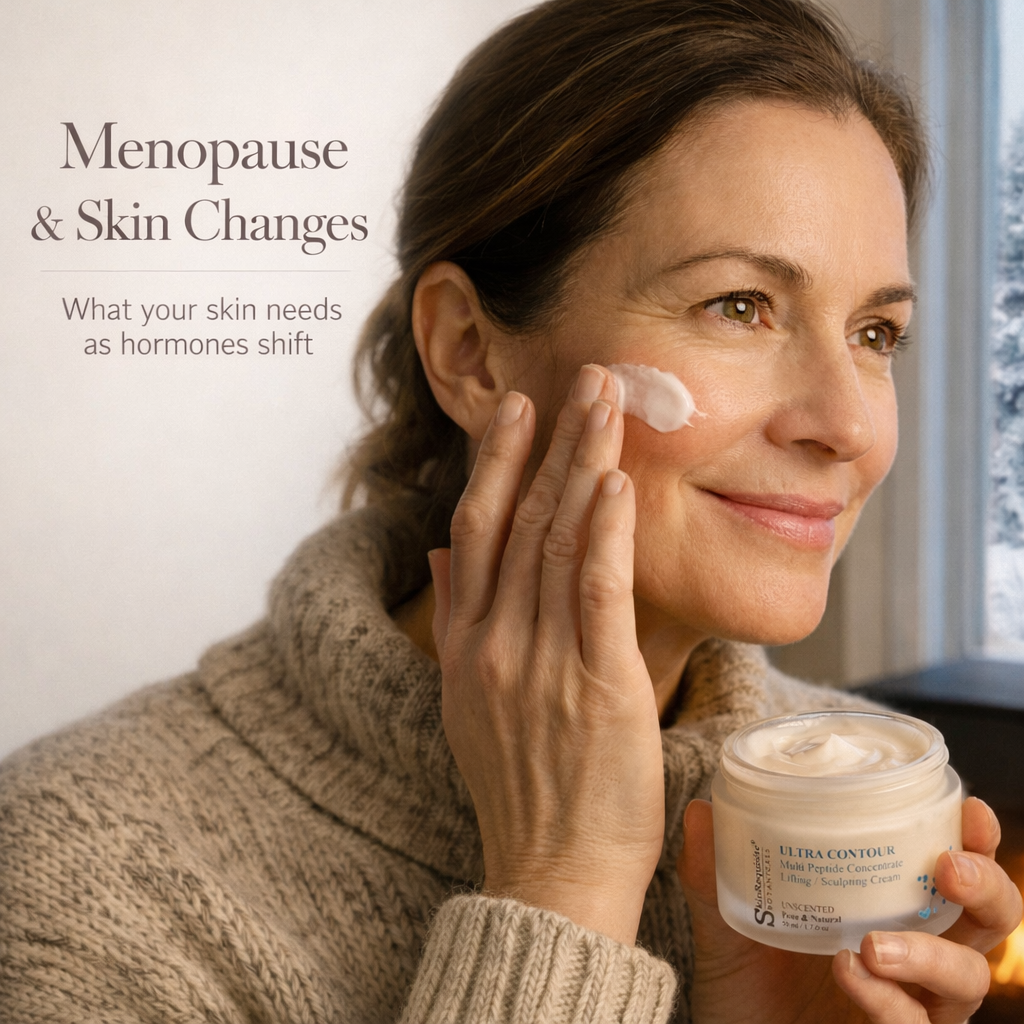
Menopause and Skin Changes
What’s Really Happening — And How to Support Your Skin Through It
For many women, menopause marks the first time their skin feels unfamiliar.
Products that once worked suddenly don’t.
Skin becomes thinner, drier, more reactive.
Redness appears where there was none.
Firmness declines faster than expected.
And yet, menopause is rarely discussed honestly in skincare.
Instead, women are told to “use stronger anti-aging products,” as if the skin simply needs more stimulation.
In reality, menopausal skin doesn’t need to be pushed.
It needs to be understood and supported.
Why Menopause Changes the Skin So Profoundly
Menopause is not a surface-level event. It’s a systemic hormonal shift, and skin is one of the most hormonally responsive organs in the body.
As estrogen declines, several key changes occur simultaneously.
1. Collagen Loss Accelerates
Estrogen plays a critical role in collagen production. During menopause, collagen can decline by up to 30% within the first five years.
This shows up as:
-
Loss of firmness
-
Thinning skin
-
Increased fine lines
-
Reduced elasticity
Unlike earlier aging, this shift can feel sudden and dramatic.
2. The Skin Barrier Weakens
Estrogen also supports lipid production — the fats that make up the skin’s protective barrier.
When estrogen drops:
-
Skin produces fewer ceramides and lipids
-
Transepidermal water loss increases
-
Skin becomes drier, tighter, and more reactive
This is why menopausal skin often feels both dry and sensitive at the same time.
3. Inflammation Increases
Lower estrogen levels are associated with higher baseline inflammation.
This can lead to:
-
Redness and flushing
-
Increased sensitivity
-
Rosacea-like symptoms
-
Slower healing
Inflammation accelerates visible aging — often more than wrinkles themselves.
4. Cell Turnover Slows
Skin renewal naturally slows with age, but menopause can amplify this effect.
As turnover decreases:
-
Skin appears dull
-
Texture becomes uneven
-
Pigmentation lingers longer
The instinct is often to exfoliate more — but this frequently worsens sensitivity instead of helping.
Why “Aggressive Anti-Aging” Backfires During Menopause
Many women respond to menopausal skin changes by increasing:
-
Retinoids
-
Acids
-
Exfoliation
-
High-strength actives
But menopausal skin is less resilient, not more.
When the barrier is already compromised and inflammation is elevated, aggressive routines often lead to:
-
Chronic irritation
-
Barrier breakdown
-
Increased redness
-
Worsening texture over time
The skin isn’t resisting treatment — it’s signaling overload.
What Menopausal Skin Actually Needs
Menopausal skin doesn’t benefit from shock therapy.
It benefits from stability, repair, and intelligent support.
1. Barrier-First Formulation
Supporting the skin barrier becomes non-negotiable.
Look for:
-
Lipid-rich formulations
-
Ceramides and fatty acids
-
Ingredients that reduce inflammation
When the barrier is strong, skin tolerates everything better — including actives.
2. Anti-Inflammatory Support
Reducing inflammation helps preserve collagen and calm reactivity.
This means prioritizing:
-
Soothing botanicals
-
Antioxidants that protect, not irritate
-
Ingredients that work with skin biology
Inflamed skin ages faster — calming it is an anti-aging strategy.
3. Gentle, Consistent Renewal
Menopausal skin still needs renewal — just not force.
Gradual stimulation supports:
-
Texture refinement
-
Brightness
-
Long-term resilience
Consistency matters more than intensity.
4. Fewer Products, Better Choices
Hormonal skin is less tolerant of constant change.
Simplifying routines often leads to:
-
Improved tolerance
-
Reduced sensitivity
-
Better long-term results
Menopausal skin thrives on predictability.
The Emotional Side of Menopausal Skin Changes
For many women, the most difficult part isn’t the dryness or fine lines — it’s the loss of recognition.
Looking in the mirror and feeling unfamiliar in your own skin can be deeply unsettling.
Menopause is not a failure of youth.
It’s a transition that requires a different kind of care.
Skin doesn’t need to be corrected for aging.
It needs to be supported through change.
A More Sustainable Philosophy for Menopausal Skin
Healthy skin during menopause is not about reversing time.
It’s about preserving function.
When skin is:
-
Calm
-
Well-hydrated
-
Protected
-
Resilient
It naturally looks smoother, brighter, and more youthful — without constant irritation.
Longevity beats intensity.
Final Thought
Menopause doesn’t mean your skin is declining.
It means your skin is asking for a new approach.
One rooted in respect for physiology, not fear of aging.
When skin is supported instead of overstimulated, it adapts — beautifully.

Written by Kamila Starczewska

Leave a comment
This site is protected by hCaptcha and the hCaptcha Privacy Policy and Terms of Service apply.