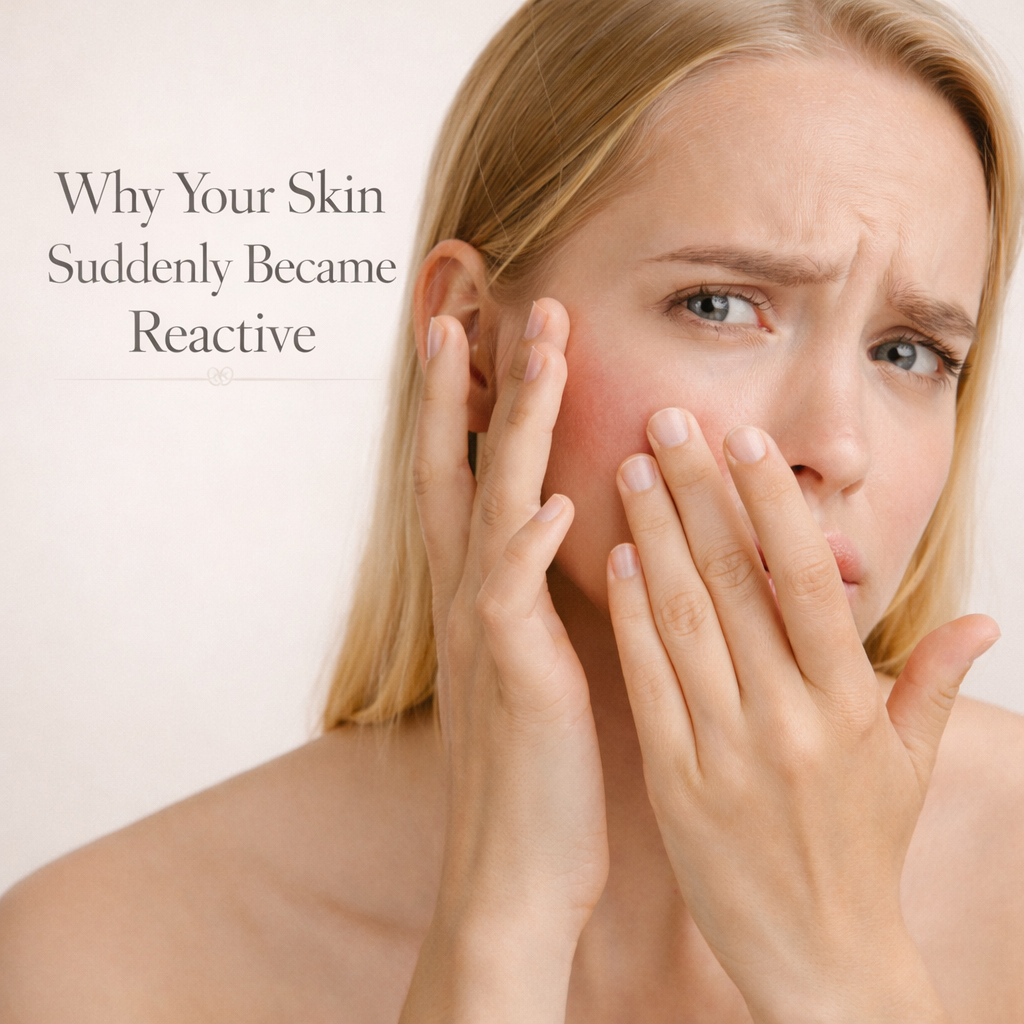
Why Your Skin Suddenly Became Reactive
One of the most common things I hear is:
“My skin was fine… and then suddenly it wasn’t.”
No major changes.
No obvious allergies.
No new diagnosis.
Yet overnight, products start burning. Redness appears. Skin feels tight, itchy, flushed, or unpredictable.
This kind of reactivity rarely comes out of nowhere. It’s usually the result of accumulated stress on the skin, not a single bad product.
Let’s talk about what’s actually happening.
1. Your Skin Barrier Was Gradually Weakened
Skin doesn’t become reactive instantly—it becomes vulnerable first.
Repeated exposure to:
-
Acids
-
Retinoids
-
Daily exfoliation
-
Strong cleansers
-
Over-cleansing
slowly compromises the barrier. Once the protective lipid matrix thins, nerve endings become exposed and inflammation rises.
That’s when even “gentle” products suddenly sting.
Reactive skin is often skin without armor.
2. You Crossed Your Skin’s Tolerance Threshold
Every skin has a limit.
You might tolerate:
-
Vitamin C
-
Retinol
-
Exfoliating acids
individually—but stacking them, increasing frequency, or using them without recovery pushes skin past its threshold.
The moment that threshold is crossed, the skin shifts from “coping” to defensive mode.
Redness, burning, and breakouts are not failures—they’re warnings.
3. Your Microbiome Was Disrupted
Your skin’s microbiome acts as a regulator of inflammation and immunity.
Over time, things like:
-
Harsh surfactants
-
Alcohol-heavy formulas
-
Antibacterial ingredients
-
Over-cleansing
can strip beneficial bacteria.
Without that microbial balance, skin becomes:
-
Less tolerant
-
More inflamed
-
Slower to heal
Reactive skin often isn’t sensitive by nature—it’s unprotected.
4. Stress Is Showing Up on Your Skin
Skin and the nervous system are deeply connected.
Chronic stress increases cortisol, which:
-
Weakens barrier repair
-
Increases inflammation
-
Delays healing
-
Heightens sensitivity
This is why skin often flares during:
-
Emotional stress
-
Poor sleep
-
Illness
-
Hormonal shifts
You can’t fully calm reactive skin without addressing internal stress signals.
5. You’re Treating Aging Skin Like Young Skin
As skin matures, it:
-
Produces fewer lipids
-
Repairs more slowly
-
Becomes less resilient
Yet many people continue using aggressive routines designed for younger, oilier, more resilient skin.
What once worked now overwhelms.
Reactive skin in your 30s and 40s is often a sign that your routine didn’t evolve as your skin did.
6. You Tried to “Fix” the First Signs of Irritation
This is a big one.
When skin shows early signs of stress—tightness, mild redness, tingling—many people respond by:
-
Exfoliating more
-
Adding more actives
-
Switching products rapidly
This accelerates damage instead of resolving it.
Irritated skin doesn’t need correction.
It needs containment and repair.
What Reactive Skin Actually Needs
Not new actives.
Not stronger formulas.
Not faster results.
Reactive skin needs:
-
Barrier repair
-
Anti-inflammatory support
-
Fewer variables
-
Time
When inflammation is reduced and the barrier is restored, sensitivity often reverses.
The Reframe That Changes Everything
Reactive skin isn’t broken.
It’s overstimulated and under-supported.
When you stop pushing and start restoring, the skin remembers how to regulate itself.
Calm skin is not passive skin.
It’s resilient skin.

Written by Kamila Starczewska

Leave a comment
This site is protected by hCaptcha and the hCaptcha Privacy Policy and Terms of Service apply.