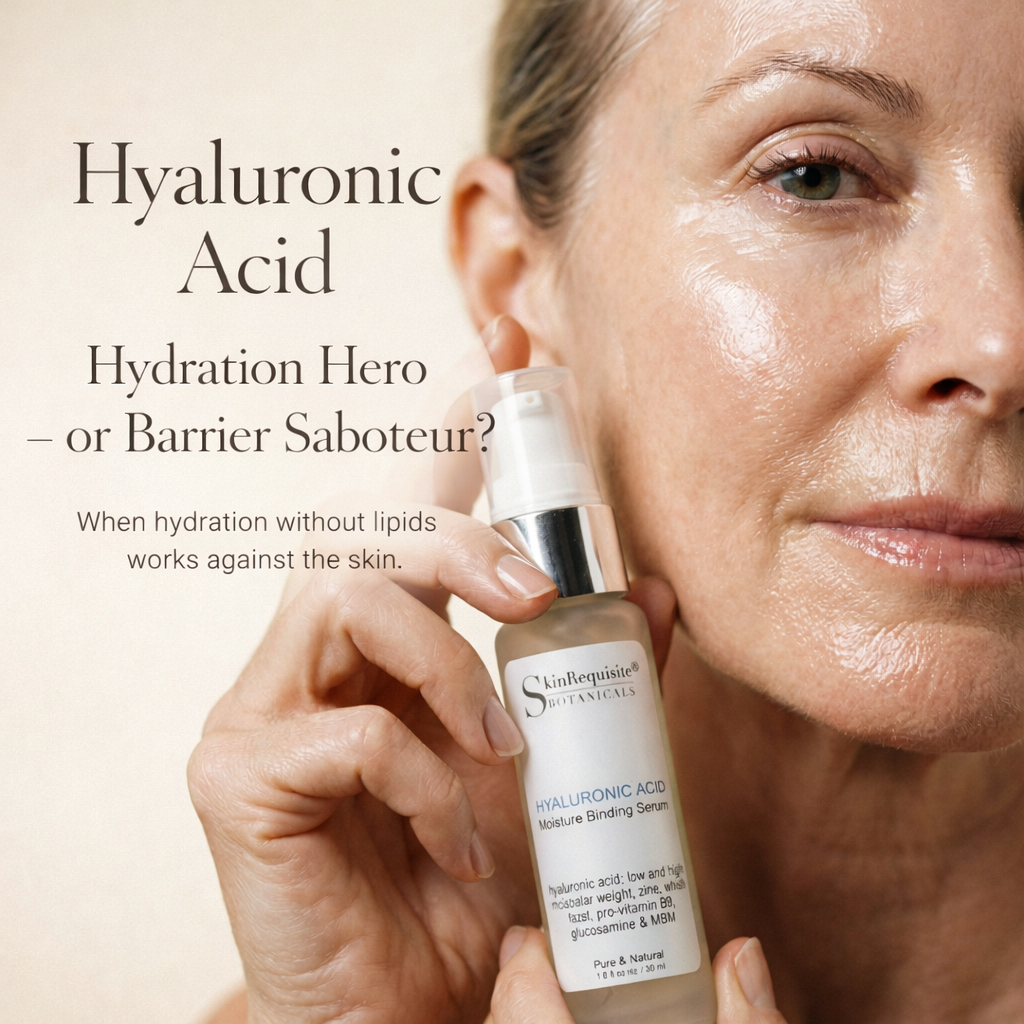
Hyaluronic Acid Hydration Hero or Barrier Saboteur?
Hyaluronic Acid is one of the most celebrated ingredients in skincare.
It’s marketed as universally safe, endlessly hydrating, and suitable for every skin type.
Yet many people report something confusing:
-
Tightness after application
-
Increased sensitivity
-
Skin that feels dry despite using hyaluronic acid
So what’s going on?
Is Hyaluronic Acid a hydration hero — or can it quietly sabotage the skin barrier?
The answer is both, depending on context.
What Hyaluronic Acid Actually Does
Hyaluronic Acid (HA) is a humectant — it attracts and binds water.
One molecule can hold up to 1,000 times its weight in water, which is why it:
-
Temporarily plumps skin
-
Improves the appearance of fine lines
-
Creates a smooth, hydrated feel
Importantly, Hyaluronic Acid does not moisturize on its own.
It does not add lipids.
It does not repair the barrier.
It simply moves water.
When Hyaluronic Acid Works Beautifully
Hyaluronic Acid performs best when:
-
The environment is humid
-
The skin barrier is intact
-
It’s layered under a lipid-rich moisturizer
-
The formulation is balanced and not overly concentrated
In these conditions, HA acts as a hydration amplifier, helping skin retain water and appear supple.
This is why it works well for:
-
Normal to resilient skin
-
Short-term plumping
-
Supporting ingredients — not replacing them
When Hyaluronic Acid Becomes a Problem
This is the part rarely discussed.
1. In Dry Climates or Heated Indoor Air
Hyaluronic Acid pulls water from wherever it can find it.
If there’s not enough moisture in the air, it may draw water out of the deeper layers of your skin instead — increasing transepidermal water loss (TEWL).
The result?
-
Skin feels tight shortly after application
-
Hydration feels fleeting
-
Dryness worsens over time
2. On a Compromised Skin Barrier
When the barrier is impaired, HA can:
-
Pull water upward without sealing it in
-
Increase dehydration
-
Expose nerve endings
-
Exacerbate sensitivity
This is why people with:
-
Over-exfoliated skin
-
Rosacea
-
Post-procedure skin
-
Menopausal or estrogen-deficient skin
often find Hyaluronic Acid irritating rather than soothing.
3. In High-Concentration or Multi-Layered HA Products
More is not better.
Highly concentrated HA or products stacked with multiple molecular weights can:
-
Create surface tightness
-
Give a false sense of hydration
-
Leave skin dependent on constant reapplication
Hydration without lipids is not stability — it’s volatility.
The “Plump but Tight” Paradox
This is a classic Hyaluronic Acid experience.
Skin may look:
-
Smooth
-
Dewy
-
Temporarily plumped
But feel:
-
Tight
-
Dry underneath
-
More reactive over time
That’s because hydration alone is not barrier repair.
Water needs lipids to stay put.
Hyaluronic Acid vs True Moisturization
Let’s clarify the difference:
Hyaluronic Acid
-
Moves water
-
Temporarily hydrates
-
Does not repair the barrier
Barrier-Supporting Ingredients
-
Reduce water loss
-
Calm inflammation
-
Strengthen skin structure
-
Improve long-term resilience
Skin health depends far more on barrier integrity than on how much water is pulled to the surface.
Who Should Be Cautious With Hyaluronic Acid
Hyaluronic Acid may not be ideal as a primary hydrator if you have:
-
Chronically dry skin
-
Sensitive or reactive skin
-
Barrier damage
-
Menopausal skin
-
Live in dry or cold climates
This doesn’t mean HA must be avoided — it means it should be used intelligently, within a supportive formulation.
How to Use Hyaluronic Acid Safely (If You Do)
If Hyaluronic Acid is part of your routine:
-
Apply to slightly damp skin
-
Always seal it with a lipid-rich moisturizer
-
Avoid over-layering multiple HA products
-
Pay attention to how your skin feels, not just how it looks
If skin feels tighter over time, that’s feedback — not coincidence.
A Better Question to Ask
Instead of asking:
“How hydrating is this product?”
Ask:
“Does this help my skin retain hydration long-term?”
That shift changes everything.
The Takeaway
Hyaluronic Acid isn’t bad.
But it’s not a universal solution — and it’s not barrier care.
For resilient skin in the right conditions, it can be a useful supporting ingredient.
For dry, sensitive, or hormonally changing skin, it can quietly worsen dehydration if used incorrectly or in isolation.
Healthy skin doesn’t just need water.
It needs structure, lipids, and calm.
Hydration without support is temporary.
Barrier health is longevity.

Written by Kamila Starczewska

Leave a comment
This site is protected by hCaptcha and the hCaptcha Privacy Policy and Terms of Service apply.