Article: Is Your Luxury Skincare Just an Alibaba Formula With a Fancy Label?
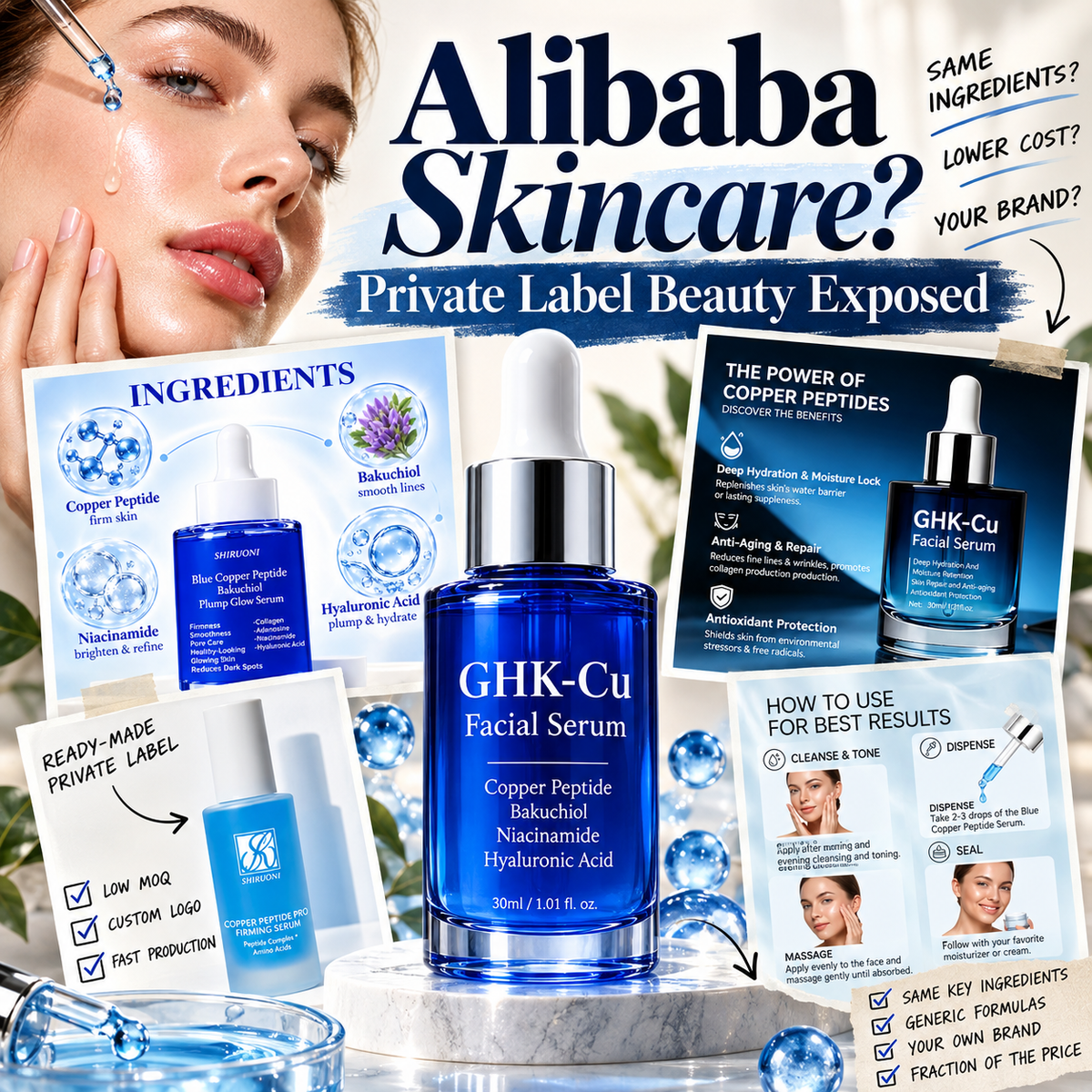
Is Your Luxury Skincare Just an Alibaba Formula With a Fancy Label?
The hidden world of private-label skincare, ready-made formulas, and the difference between building a beauty brand and actually formulating skincare.
Imagine spending $95 on a luxurious anti-aging serum. The packaging is beautiful. The website promises cutting-edge skincare science. The brand tells a compelling story about carefully selected ingredients, innovation, and skin transformation.
Now imagine discovering that an identical or nearly identical formula may be available from a wholesale manufacturer for a fraction of that price—ready for someone to put their own logo on the bottle.
Welcome to the world of private-label skincare, where launching a beauty brand doesn't necessarily mean developing a beauty product.
And the surprising part? This isn't some underground industry secret. It's an openly advertised business model.
The Skincare Brand That Never Formulated Its Own Skincare
Platforms like Alibaba connect businesses with manufacturers offering everything from facial cleansers and moisturizers to vitamin C serums, peptide treatments, and elaborate anti-aging skincare collections.
Many suppliers offer private-label or white-label services.
The concept is remarkably simple:
-
Choose a skincare product from a manufacturer's existing catalog.
-
Select a bottle, jar, or other packaging.
-
Add your company's logo and custom label.
-
Purchase the required minimum quantity.
-
Market the finished product under your own brand name.
Some manufacturers even provide packaging design, promotional materials, and assistance with product branding.
In some cases, the underlying formula already exists before the beauty brand is even conceived.
The business owner may never have selected the ingredients, calculated the active concentrations, adjusted the pH, or participated in the formulation's development.
Yet the product can still arrive looking like something from a luxury beauty counter.
The packaging is personalized. The formula may not be.
See for Yourself: Copper Peptide Serums Available on Alibaba
Copper peptides, particularly GHK-Cu, have become increasingly popular in skincare marketing.
They're associated with skin renewal, improved appearance of fine lines, and research involving collagen-related processes.
But what happens when a sophisticated-sounding ingredient becomes another mass-marketed product category?
A search on Alibaba reveals a marketplace of ready-made and private-label copper peptide skincare products.
Here are five actual listings that illustrate what's available to businesses looking to enter the skincare market.
1. Private-Label Blue GHK-Cu Copper Peptide
View the actual Alibaba listing
A product advertised specifically around private-label blue copper peptide skincare.
The phrase private label is right in the product listing. It illustrates how easily businesses can discover products they may be able to market under their own brand identity.
2. Wholesale Anti-Wrinkle, Firming and Hydrating Skincare
View the actual Alibaba listing
The familiar language of premium skincare—firming, moisturizing, hydrating, and anti-wrinkle—also appears throughout wholesale marketplaces.
These are the same types of benefits that often feature prominently in luxury skincare advertisements.
3. Natural Organic GHK-Cu Face Serum
View the actual Alibaba listing
This listing combines the appeal of copper peptides with terminology such as natural and organic.
But marketing terminology alone doesn't establish ingredient origin, certification, active concentration, or finished-product performance.
4. Private-Label Blue Copper Peptide Skincare
View the actual Alibaba listing
Another example of a product marketed toward businesses interested in private-label copper peptide skincare.
It demonstrates that brand owners can encounter products already positioned around popular cosmetic ingredients.
5. GHK-Cu Blue Copper Peptide + Bakuchiol Serum
View the actual Alibaba listing
This example is particularly interesting because it combines several fashionable skincare ingredients in a single product concept.
The promotional photography highlights copper peptides, bakuchiol, niacinamide, and hyaluronic acid.
It's the kind of ingredient story that could easily appear in a premium skincare campaign.
But an attractive list of active ingredients tells us very little about their actual concentrations, stability, compatibility, or the finished product's clinical performance.
Important distinction: These listings demonstrate the availability of wholesale skincare products. They do not establish that any particular retail skincare brand purchases or resells these exact formulas, nor do they independently verify the quality of the advertised products.
Private Label, White Label, and Custom Formulation: What's the Difference?
These terms are frequently used interchangeably, but understanding them reveals an important distinction.
White-label skincare generally refers to ready-made formulations sold under another company's branding, with little or no modification to the underlying formula.
Private-label skincare refers more broadly to products manufactured for sale under a retailer's own brand. They may be existing formulas or customized products.
Custom formulation involves developing or substantially modifying a formula to meet specific ingredient, performance, sensory, and product requirements.
Not all private-label brands use generic formulas. Some collaborate extensively with cosmetic chemists and manufacturers to create genuinely distinctive products.
And not every brand that develops original formulas owns a factory. Contract manufacturing is a legitimate and often sophisticated part of the cosmetics industry.
The distinction is not who physically fills the bottle. It's who develops the formula, understands its chemistry, validates its performance, and takes responsibility for the finished product.
The Luxury Skincare Illusion: Are You Paying for Ingredients or Marketing?
A beautifully designed bottle can communicate exclusivity.
A scientific-sounding product name can create credibility.
A polished advertising campaign can make a serum feel revolutionary.
But none of these things establishes whether the formula itself is innovative.
Consider two hypothetical products.
Serum A — $95
Luxury presentation, elaborate marketing, and a ready-made formula.
Serum B — $45
A custom-developed formula with documented active concentrations and a clear formulation rationale.
Which serum is better?
The price cannot answer that question.
Serum A could be beautifully manufactured, stable, safe, and effective. Serum B could be poorly executed despite its custom development.
The point is that luxury pricing and luxury formulation are not the same thing.
Consumers should not have to rely exclusively on branding to determine whether a skincare product deserves its price.
Your Skincare Ingredient List Doesn't Tell the Whole Story
Many skincare brands advertise recognizable active ingredients:
-
Copper peptides
-
Vitamin C
-
Niacinamide
-
Hyaluronic acid
-
Ceramides
-
Retinoids
-
Botanical antioxidants
But simply including a popular ingredient doesn't establish that the finished product contains a meaningful amount—or that the ingredient remains stable and available in the formula.
Take copper peptides as an example.
A serum marketed as containing GHK-Cu could contain a substantial amount of pure Copper Tripeptide-1, or it could contain a small quantity of a diluted supplier solution.
Both might advertise copper peptides.
The label alone may not disclose the concentration of pure active peptide.
Likewise, a vitamin C serum's performance depends on more than the words Vitamin C on its packaging. The form of vitamin C, concentration, pH, solvent system, packaging, and stability all contribute to the finished product's behavior.
A product can list excellent ingredients and still be poorly designed.
Formulation is not simply putting fashionable ingredients together. It's understanding how those ingredients function as a complete system.
For more insight into copper peptide concentrations, explore our SkinRequisite skincare education blog.
Why Ready-Made Skincare Isn't Automatically Bad
Let's make an important distinction.
Buying a ready-made formula from a manufacturer doesn't automatically make a beauty brand dishonest, nor does it automatically make the product low quality.
Experienced cosmetic manufacturers can produce excellent formulas.
They may employ qualified chemists, conduct stability testing, maintain quality-control procedures, and use sophisticated manufacturing equipment.
Some of the world's most recognizable beauty businesses outsource manufacturing.
The country of manufacture is not, by itself, an indication of product quality either.
What matters is the quality of the formulation, manufacturing practices, testing, transparency, and accountability.
The problem begins when marketing implies proprietary scientific development that never actually occurred, or when a company makes performance claims without adequate evidence.
There's a meaningful difference between saying:
We've carefully selected a professionally manufactured skincare formula.
And suggesting:
Our scientists spent years developing this groundbreaking proprietary technology.
If the latter story isn't true, consumers are being sold an impression rather than an accurate account of the product.
What About Product Safety and FDA Regulations?
Another common misconception is that skincare products must receive FDA approval before being sold in the United States.
For products legally classified as cosmetics, FDA premarket approval is generally not required, except for certain color additives.
Cosmetics are nevertheless subject to federal safety and labeling requirements.
The Modernization of Cosmetics Regulation Act of 2022 (MoCRA) strengthened oversight and requires responsible persons to maintain adequate safety substantiation for cosmetic products, subject to applicable provisions and exemptions.
That responsibility doesn't simply disappear because a formula was purchased from an overseas supplier.
Responsible skincare businesses should be able to address questions about product quality and safety, including appropriate microbiological testing, preservative effectiveness, stability, ingredient documentation, and packaging compatibility.
A manufacturer's attractive catalog is not a substitute for that diligence.
Five Questions Every Skincare Consumer Should Ask
You don't need a chemistry degree to become a more informed skincare buyer.
Before investing in an expensive serum or moisturizer, consider asking:
1. Is this an original formula or a ready-made private-label product?
There's nothing inherently wrong with either approach. Transparency is what matters.
2. Does the brand disclose meaningful concentrations of its featured active ingredients?
Not every ingredient concentration must appear on a cosmetic label, and disclosure is not always commercially practical.
But when a specific active is the central selling point, clear information can help consumers evaluate the claim.
3. Can the company explain why particular ingredients were selected?
A knowledgeable brand should be able to discuss what its ingredients are intended to do and how they fit into the overall formulation.
4. Is the product tested for stability and safety?
Especially with water-based serums, creams, and products containing sensitive active ingredients, appropriate product testing is an essential part of responsible development.
5. Are the claims supported by evidence, or just beautiful marketing?
Words such as advanced, medical-grade, revolutionary, and luxury do not automatically establish clinical performance.
A brand's ability to explain its science is far more informative than its ability to create an impressive advertisement.
Why SkinRequisite Takes a Different Approach
At SkinRequisite, our philosophy begins with formulation—not packaging trends.
We believe skincare should be developed with a clear understanding of ingredient function, skin physiology, compatibility, and the integrity of the finished formula.
Our approach prioritizes thoughtfully selected active ingredients, barrier-supportive formulations, and transparency about what goes into our products.
We don't believe a skincare product becomes exceptional simply because it comes in an expensive bottle or carries a luxury price tag.
We believe the quality of the formulation should come first.
That philosophy is especially important with ingredients such as copper peptides, vitamin C, niacinamide, and other actives where concentration, compatibility, and formulation conditions can influence product performance.
Our goal isn't to sell the illusion of skincare science. It's to make formulation science meaningful to the people using our products.
The Bottom Line: A Logo Is Not a Formulation
The modern beauty industry has made it easier than ever to start a skincare brand.
With ready-made formulas, customizable packaging, and manufacturers accessible through online marketplaces, a company can bring products to market without personally developing the formulas.
That accessibility is not inherently a bad thing. It has helped countless businesses enter an industry that once required substantial manufacturing investment.
But consumers deserve to understand the difference between brand creation and product innovation.
A beautiful logo doesn't establish efficacy.
An expensive bottle doesn't guarantee superior ingredients.
A compelling founder story doesn't prove that the founder developed the formula.
And a luxury price doesn't make an ordinary formulation extraordinary.
The next time a skincare brand promises a revolutionary serum, look beyond the packaging.
Ask what makes the formula different. Ask about the active ingredients. Look for evidence behind the claims.
Because at the end of the day, your skin doesn't recognize brand names. It responds to the formulation inside the bottle.
Where Nature Meets Performance for Health-Conscious Beauty.
Explore SkinRequisite skincare.
Editorial disclosure: Alibaba product images and listing references are used as examples of publicly advertised wholesale skincare. Product descriptions reflect suppliers' promotional materials and are not independent verification of product performance, composition, or safety.

Written by Kamila Starczewska

Leave a comment
This site is protected by hCaptcha and the hCaptcha Privacy Policy and Terms of Service apply.