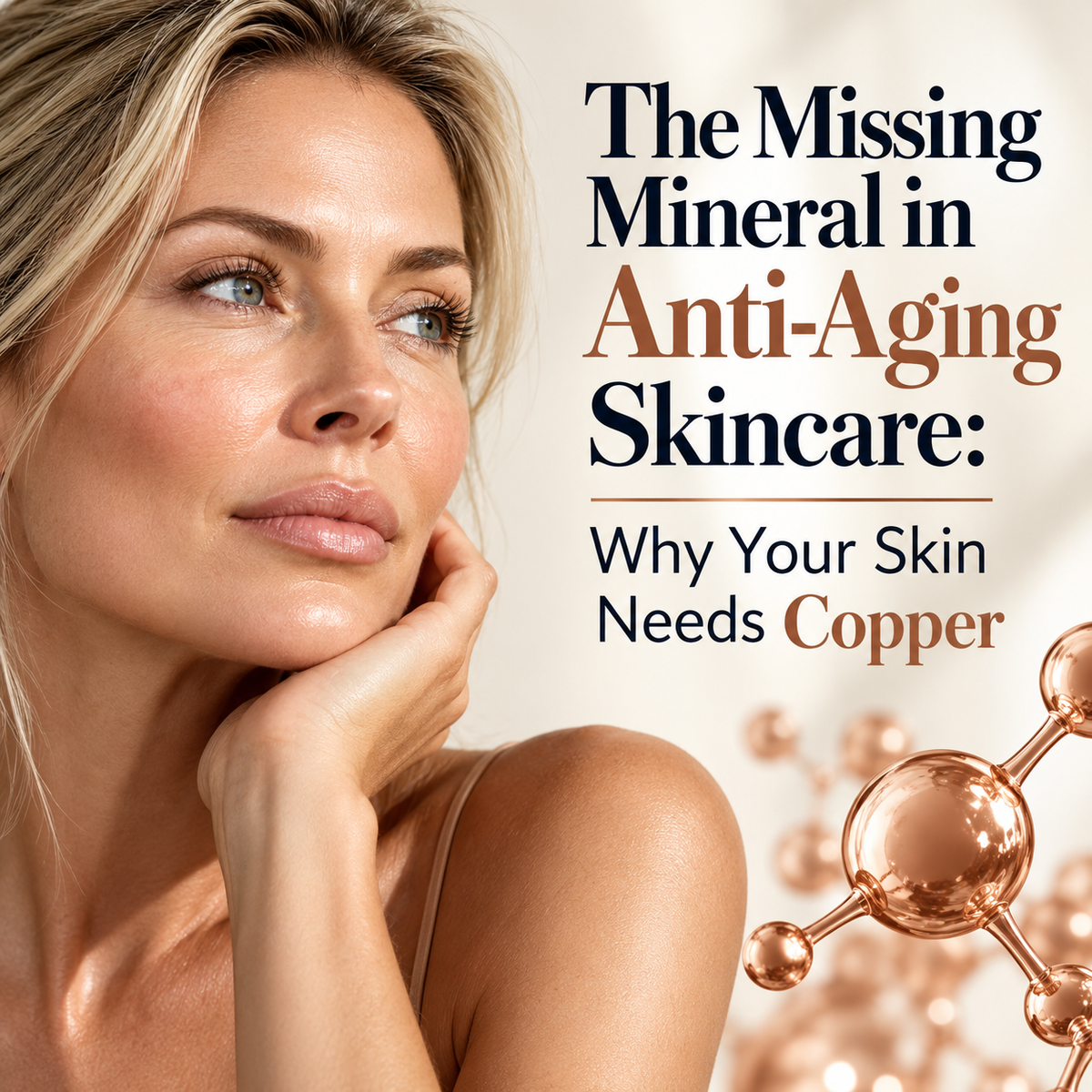
The Missing Mineral in Anti-Aging Skincare: Why Your Skin Needs Copper
The Missing Mineral in Anti-Aging Skincare: Why Your Skin Needs Copper
Collagen gets the attention. Vitamin C gets the spotlight. Retinoids get the headlines. But there's an essential trace mineral working behind the scenes of healthy skin structure—and most skincare conversations barely mention it.
That mineral is copper.
When we think about youthful-looking skin, we usually focus on collagen production, hydration, and antioxidant protection. Yet an essential mineral plays a remarkable role in the biological processes that help maintain skin's strength, elasticity, and structural integrity.
Copper is involved in collagen and elastin stabilization, cellular antioxidant defense, connective tissue maintenance, and normal skin pigmentation.
It is also a key component of one of the most fascinating ingredients in advanced peptide skincare: GHK-Cu, also known as Copper Tripeptide-1.
But what exactly does copper do for your skin? Can it help with visible signs of aging? And what makes copper peptides different from ordinary copper?
Let's explore the science behind this often-overlooked mineral.
1. Copper Is Essential for Collagen and Elastin Integrity
Collagen and elastin are two of the most important structural proteins in the skin.
Collagen contributes to strength and firmness, while elastin allows tissues to stretch and recover their shape.
As we age, changes in the production, organization, and degradation of these proteins contribute to wrinkles, reduced firmness, and loss of elasticity.
But producing collagen and elastin is only part of the process.
These structural proteins must also be properly organized and stabilized.
That's where copper plays a critical biological role.
The Copper-Dependent Enzyme Behind Connective Tissue Strength
Lysyl oxidase, commonly abbreviated LOX, is an enzyme responsible for initiating cross-linking reactions involving collagen and elastin.
These molecular cross-links help provide connective tissues with mechanical strength and structural integrity.
Think of collagen and elastin as fibers woven into a fabric.
The fibers themselves are important, but the connections between them help the fabric remain stable and resilient.
Lysyl oxidase contributes to creating those connections.
And importantly, lysyl oxidase requires copper to function normally.
Insufficient copper availability can impair this enzyme's activity, interfering with normal connective tissue development and maintenance.
What Does This Mean for Aging Skin?
With age, collagen architecture and elastin organization undergo changes that affect skin appearance and mechanical properties.
Copper's involvement in connective tissue stabilization makes it essential to normal skin physiology.
However, there is an important distinction between copper's biological function and the effects of topical skincare.
Although copper is required for normal lysyl oxidase activity, applying additional copper to the skin has not been proven to automatically increase collagen cross-linking or reverse structural aging.
Skin health depends on balanced biological processes—not simply increasing the amount of an individual ingredient.
To explore the broader factors influencing collagen, elasticity, and visible aging, read our guide to how to reduce wrinkles naturally through skin science.
2. Copper Supports the Skin's Natural Antioxidant Defense System
Every day, our skin encounters environmental and internal sources of oxidative stress.
Ultraviolet radiation, pollution, and normal cellular metabolism can generate reactive oxygen species, commonly called ROS.
These molecules participate in normal cellular signaling, but excessive accumulation can damage proteins, lipids, and other cellular components.
Over time, oxidative stress can contribute to visible skin aging.
The body relies on several antioxidant defense systems to help regulate these processes.
One of them depends on copper.
Copper and Superoxide Dismutase
Copper-zinc superoxide dismutase, also known as Cu/Zn-SOD or SOD1, is an antioxidant enzyme found in many human cells.
It contains copper and zinc and helps convert superoxide radicals into less reactive molecules.
Copper plays an essential catalytic role in this enzyme.
This means copper contributes to one of the body's naturally occurring antioxidant defense mechanisms.
Does Copper Work Like Vitamin C?
Not exactly.
Although copper participates in antioxidant enzyme activity, that does not mean free copper applied topically functions like a conventional antioxidant serum.
In fact, unbound copper ions can participate in chemical reactions that generate reactive oxygen species under certain conditions.
This highlights an important principle of mineral biology:
Copper is essential, but its chemical form, availability, and regulation matter.
The body carefully manages copper through specialized transport proteins and copper-binding molecules.
This is one reason copper-containing complexes, including GHK-Cu, have attracted scientific interest.
For a broader understanding of how antioxidant protection, barrier function, and cellular processes influence the condition of your skin, explore Functional Skin Restoration: Why Your Skin Isn't Improving.
3. Copper Participates in Skin Remodeling and Connective Tissue Maintenance
Your skin is constantly adapting to its environment.
Even when no visible changes are occurring, cells are involved in maintaining proteins, regulating communication, and managing the extracellular matrix.
The extracellular matrix, or ECM, is a complex network containing collagen, elastin, proteoglycans, and glycosaminoglycans.
It contributes to skin's structure, organization, and mechanical characteristics.
Why the Extracellular Matrix Matters
A healthy extracellular matrix requires balance between several processes:
-
Production of structural proteins
-
Organization and stabilization of collagen and elastin
-
Controlled breakdown of older matrix components
-
Maintenance of normal tissue architecture
-
Communication between cells and their surrounding environment
Fibroblasts, the main connective tissue-producing cells of the dermis, are involved in many of these activities.
Research has investigated copper's role in connective tissue biology and the influence of copper-containing compounds on fibroblast behavior.
Copper-binding peptides, including GHK-Cu, have attracted interest because laboratory studies suggest they may interact with pathways involved in extracellular matrix remodeling.
Remodeling Is Not the Same as Simply Producing More Collagen
Skin maintenance requires coordination between synthesis, organization, and degradation.
Producing more collagen without proper organization would not necessarily improve skin quality.
This is why modern skin science increasingly considers the extracellular matrix as an interconnected system rather than focusing on a single structural protein.
Healthy-looking skin depends on the relationship between structure, hydration, barrier function, and biological resilience.
We explore this broader approach in Strong Skin Ages Slower: The Power of Skin Resilience.
4. Copper Contributes to Normal Tissue Repair Processes
Copper is involved in several physiological processes associated with tissue maintenance and repair.
These include connective tissue formation, enzyme activity, and cellular functions involved in angiogenesis—the development of new blood vessels from existing ones.
Researchers have examined copper-containing materials in wound-care settings, including experimental dressings and other medical applications.
Certain studies suggest that appropriately designed copper-containing materials may influence processes relevant to tissue repair.
What Does This Mean for Cosmetic Skincare?
The relevance lies in understanding how copper participates in the biology of skin maintenance.
Some biological pathways involved in tissue repair are also relevant to extracellular matrix regulation and normal skin function.
However, wound-healing research should not be used as evidence that a cosmetic facial serum can heal wounds, repair damaged tissue, or reproduce the effects of a medical dressing.
Medical wound-care products and cosmetic skincare products have different purposes, formulations, and evidence requirements.
For cosmetic skincare, the appropriate focus is the appearance of skin texture, hydration, firmness, and visible signs of aging.
5. What Makes GHK-Cu Different from Ordinary Copper?
Not all copper-containing skincare ingredients are chemically identical.
Copper may be incorporated into cosmetic formulas as a salt, a coordination complex, or a peptide-bound ingredient.
One of the most extensively discussed copper-binding peptides is GHK-Cu.
Understanding Copper Tripeptide-1
GHK is a tripeptide composed of three amino acids:
-
Glycine (G)
-
Histidine (H)
-
Lysine (K)
Together, they form the naturally occurring tripeptide glycyl-L-histidyl-L-lysine.
GHK can bind copper ions, forming the complex known as GHK-Cu.
This coordination between the peptide and copper gives the complex properties that differ from those of a simple copper salt.
Why Researchers Are Interested in GHK-Cu
Laboratory investigations have examined GHK-Cu's relationships with biological pathways associated with:
-
Fibroblast activity
-
Extracellular matrix regulation
-
Collagen-related processes
-
Cellular signaling
-
Tissue remodeling
These findings help explain why Copper Tripeptide-1 has become an increasingly popular ingredient in advanced cosmetic skincare.
However, the fact that GHK-Cu demonstrates biological activity in a laboratory does not prove that every topical product containing it will produce identical effects.
Finished-product performance depends on factors such as concentration, chemical stability, delivery, ingredient compatibility, and skin tolerance.
Is GHK-Cu a Copper Delivery System?
GHK is often described as a copper-binding or copper-carrier peptide.
Its ability to bind copper is established, but the amount of copper delivered to specific skin layers by a finished topical serum cannot be determined from ingredient identity alone.
That requires appropriate formulation and penetration testing.
This distinction matters when evaluating claims about copper peptide skincare.
6. Copper and Skin Elasticity: What Does the Science Say?
Skin elasticity describes the ability of skin to deform and recover its shape.
It depends on several interconnected factors, including elastin architecture, collagen organization, hydration, and the mechanical behavior of the extracellular matrix.
Copper contributes to normal connective tissue biology because of its role in copper-dependent enzymes such as lysyl oxidase.
But does applying copper peptides make facial skin visibly firmer?
What Is Scientifically Established?
Copper is essential for normal lysyl oxidase function and connective tissue cross-linking.
What Is Being Investigated?
GHK-Cu has been studied for biological interactions associated with extracellular matrix regulation and aging-related processes.
What Remains Uncertain?
Whether a particular GHK-Cu facial serum consistently improves visible wrinkles, firmness, or elasticity—and by how much—requires controlled human clinical research.
Some preliminary topical copper peptide studies have reported encouraging cosmetic observations, but results have not been uniformly positive, and the evidence remains limited.
Copper's established role in skin physiology should not be confused with proven anti-aging performance from every copper-containing serum.
That distinction is central to responsible skincare science.
7. Copper Also Plays a Role in Skin Pigmentation
Copper has another fascinating biological function: it is involved in melanin production.
Melanin is the pigment responsible for much of the natural coloration of skin and hair.
A key enzyme involved in melanin synthesis is tyrosinase.
Tyrosinase contains copper ions that are essential for its catalytic function.
Does This Mean Copper Peptides Cause Hyperpigmentation?
Not necessarily.
Although copper participates in normal pigmentation biology, that does not establish that topical GHK-Cu increases pigmentation or causes dark spots.
The presence of copper within a peptide complex does not automatically translate into greater tyrosinase activity in living skin.
Likewise, claims that copper peptides reliably correct pigmentation concerns require appropriate clinical evidence.
The relationship between copper, tyrosinase, and pigmentation illustrates an important point:
An ingredient's biological role does not necessarily predict the cosmetic outcome of applying it topically.
8. Why Copper Balance Matters More Than Copper Excess
Copper is an essential trace element, but the body requires it in carefully regulated amounts.
Copper deficiency can impair the normal functioning of copper-dependent enzymes.
Excessive copper exposure can also be harmful, particularly when copper availability exceeds the capacity of biological systems to regulate it.
Unbound copper ions can participate in oxidation reactions under certain chemical conditions.
For this reason, copper is carefully transported and bound by specialized proteins and molecules within the body.
What Does This Mean for Copper Peptide Formulation?
In cosmetic formulation, the amount of copper peptide is only one consideration.
Other important factors include:
-
The chemical identity of the copper complex
-
Formulation pH
-
Ingredient compatibility
-
Stability during storage
-
Potential interactions with other copper-binding ingredients
-
Finished-product skin tolerance
A higher concentration does not automatically establish superior performance.
The scientific value of a copper peptide formula depends on how the ingredient behaves within the completed product.
More is not always better. Thoughtful formulation matters.
9. Why SkinRequisite Chose GHK-Cu for Advanced Peptide Skincare
At SkinRequisite, our approach to skincare begins with understanding the biology of skin function.
We believe meaningful skincare formulation involves more than following ingredient trends or emphasizing increasingly high percentages.
Our Copper Peptide Renewal Serum was developed around GHK-Cu because of the scientific interest surrounding its copper-binding chemistry and interactions with extracellular matrix-related processes.
100 mg of Pure GHK-Cu in Every 30 mL Bottle
Our formula contains:
100 mg pure GHK-Cu per bottle
3.33 mg GHK-Cu per milliliter
Approximately 0.33% Copper Tripeptide-1 (w/v)
This concentration refers to the copper peptide complex itself, rather than the percentage of a diluted supplier solution.
We believe that customers deserve transparency about the amount of a featured ingredient incorporated into their skincare.
A Multifunctional Peptide and Hydration Complex
In addition to GHK-Cu, our formula incorporates complementary cosmetic ingredients.
Acetyl Octapeptide-3 | Expression-Line Peptide
A cosmetic peptide used in formulations targeting the appearance of expression lines and wrinkles.
Panthenol | Pro-Vitamin B5
A moisturizing and conditioning ingredient that helps support softness, suppleness, and skin barrier comfort.
Low-Molecular-Weight Hyaluronic Acid | Hydration Support
A moisture-binding humectant that helps maintain hydration and contributes to a smoother, plumper-looking complexion.
Allantoin | Skin-Conditioning Support
An ingredient valued for helping maintain a soft and comfortable skin surface.
Together, these ingredients create a multifunctional cosmetic treatment designed for skin experiencing visible fine lines, uneven texture, dehydration, and reduced firmness.
The Importance of a Healthy Skin Barrier
Targeted peptides are only one part of an effective skincare routine.
A well-conditioned skin barrier helps maintain hydration and limits excessive moisture loss.
Ingredients such as niacinamide can complement a broader skincare approach by supporting barrier function and skin conditioning.
Learn more in our article Niacinamide for Skin: Benefits, Science & How It Transforms Your Barrier.
At SkinRequisite, our philosophy is to combine targeted actives with complementary ingredients that support the appearance and comfort of the skin.
10. Frequently Asked Questions About Copper and Skin
Is Copper Good for Aging Skin?
Copper is essential to normal skin biology, including enzymes involved in connective tissue maintenance and antioxidant defense. Copper peptide skincare is being investigated for visible signs of aging, but cosmetic benefits depend on the specific formulation and supporting evidence.
Does Copper Help Produce Collagen?
Copper is required for lysyl oxidase, an enzyme involved in collagen cross-linking and stabilization. Laboratory research has also investigated copper-containing compounds and collagen-related pathways. However, applying additional copper topically has not been established as a reliable way to increase collagen production in human facial skin.
Can Copper Improve Skin Elasticity?
Copper contributes to normal connective tissue structure through copper-dependent enzyme activity. Whether a specific topical copper peptide serum measurably improves skin elasticity requires controlled human testing.
What Does GHK-Cu Do for the Face?
GHK-Cu is a copper-binding peptide investigated for its interactions with biological pathways associated with extracellular matrix remodeling and skin aging. It is incorporated into cosmetic products targeting the appearance of fine lines, uneven texture, and loss of firmness.
Is Copper the Same as GHK-Cu?
No. Copper is an essential chemical element. GHK-Cu is a complex formed when the tripeptide GHK binds copper. Its chemical properties differ from those of unbound copper ions or simple copper salts.
Can Copper Peptides Help Support the Skin Barrier?
Some copper peptide products contain hydrating and conditioning ingredients that support skin comfort and moisture retention. Whether GHK-Cu itself produces a measurable improvement in barrier function depends on the evidence for the specific formulation.
Can I Get the Same Benefits from Copper Supplements?
Adequate dietary copper supports normal biological functions, but copper supplements are not established treatments for cosmetic skin aging. Supplementation is not equivalent to applying GHK-Cu topically, and excessive copper intake can be harmful.
Can Copper Peptides Be Used Every Day?
Some finished copper peptide serums are designed for daily use. Application frequency should follow product directions and individual skin tolerance. Patch testing is advisable when introducing a new treatment.
The Bottom Line: Copper Is More Than an Anti-Aging Trend
Collagen and elastin receive much of the attention in anti-aging skincare.
Yet the biological processes supporting these structural proteins depend on more than collagen production alone.
Copper is an essential part of that larger system.
Its involvement in lysyl oxidase activity, antioxidant enzymes, connective tissue maintenance, and pigmentation biology makes it an important trace mineral in skin physiology.
The development of copper-binding peptides such as GHK-Cu has created new opportunities for cosmetic research.
Although questions remain about optimal topical concentrations, delivery, and clinical efficacy, the underlying science offers a fascinating perspective on the connection between minerals, peptides, and skin aging.
At SkinRequisite, we believe advanced skincare should begin with an understanding of these relationships.
Because youthful-looking skin isn't simply about applying more ingredients.
It's about understanding the complex biology that supports healthy skin—and formulating with intention.
Skin health first. Science-informed skincare. Ingredient transparency without compromise.
SkinRequisite — Where Nature Meets Performance for Health-Conscious Beauty.
Discover SkinRequisite Copper Peptide Renewal Serum
100 mg Pure GHK-Cu | 0.33% Copper Tripeptide-1 | Advanced Peptides + Hydration
Discover our concentrated copper peptide formula combining GHK-Cu with complementary peptides, humectants, and conditioning ingredients for smoother, more hydrated, firmer-looking skin.
Explore SkinRequisite Copper Peptide Renewal Serum
Scientific References
-
Rucker, R. B., et al. (1998). Copper, Lysyl Oxidase, and Extracellular Matrix Protein Cross-Linking. American Journal of Clinical Nutrition. https://pubmed.ncbi.nlm.nih.gov/9587142/
-
Pickart, L., & Margolina, A. (2018). Regenerative and Protective Actions of the GHK-Cu Peptide in the Light of the New Gene Data. International Journal of Molecular Sciences, 19(7), 1987. https://pmc.ncbi.nlm.nih.gov/articles/PMC6073405/
-
Pickart, L., & Margolina, A. (2015). GHK Peptide as a Natural Modulator of Multiple Cellular Pathways in Skin Regeneration. BioMed Research International. https://pmc.ncbi.nlm.nih.gov/articles/PMC4508379/
-
Topically Applied GHK as an Anti-Wrinkle Peptide: Advantages, Problems and Prospective. (2025). https://pmc.ncbi.nlm.nih.gov/articles/PMC11830136/
-
Skin Minerals: Key Roles of Inorganic Elements in Skin Physiological Functions. (2022). https://pmc.ncbi.nlm.nih.gov/articles/PMC9181837/
Scientific disclaimer: This article discusses copper's established physiological roles and research involving copper-containing ingredients. These findings do not establish that applying a cosmetic copper peptide serum reproduces every biological function of copper in human skin. The finished SkinRequisite Copper Peptide Renewal Serum has not undergone clinical efficacy testing. Individual results may vary.

Written by Kamila Starczewska


Leave a comment
This site is protected by hCaptcha and the hCaptcha Privacy Policy and Terms of Service apply.