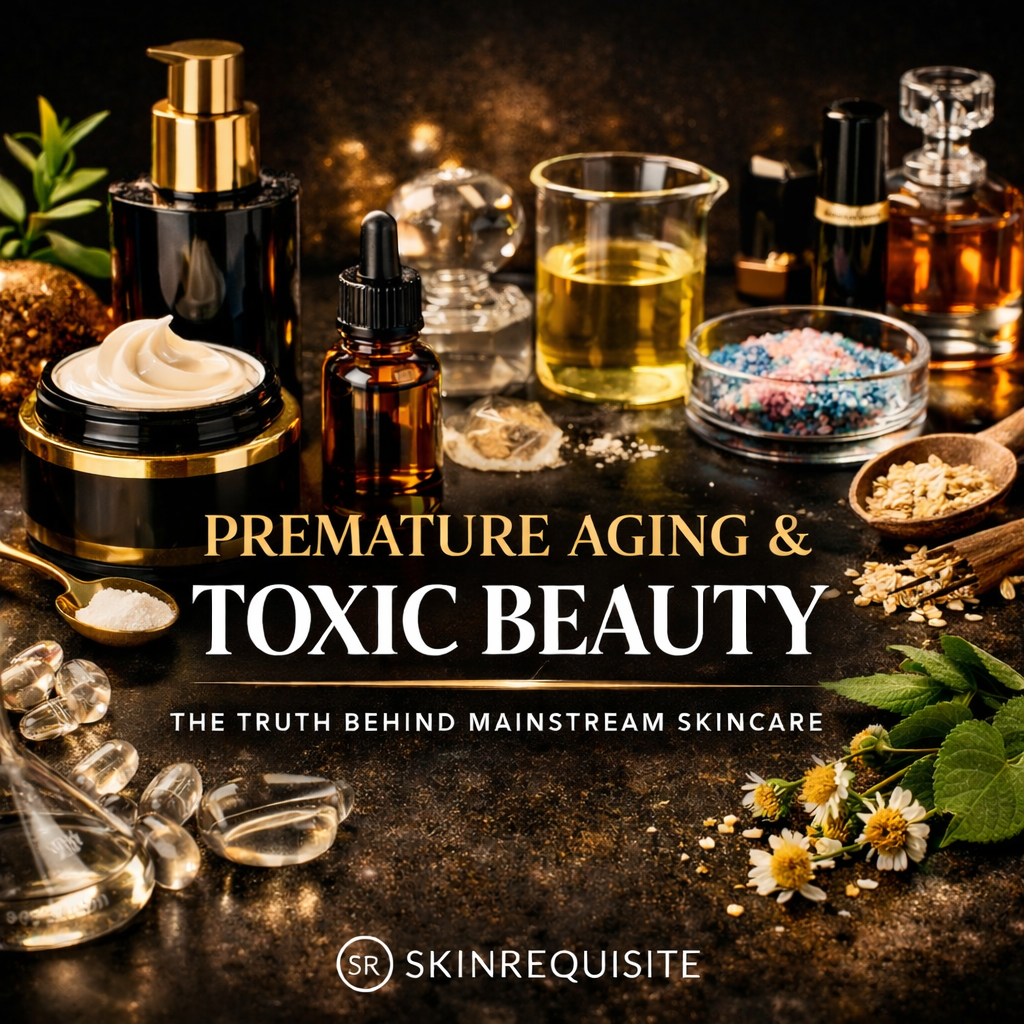
Premature Aging & The Hidden Cost of Mainstream Skincare
Walk into any beauty store and you’re met with prestige packaging, celebrity endorsements, and promises of “clinically proven” transformation.
The logic feels simple:
If a big-name brand spends millions developing a product, it must be good for my skin… right?
Not necessarily.
The truth is, most large cosmetic companies are structured around profit margins — not skin physiology. Marketing budgets often exceed formulation budgets. Airbrushed models, glossy campaigns, and luxury jars create the illusion of performance long before the formula ever touches your skin.
And that’s where the real issue begins.
The 1% Illusion
Many mainstream products highlight a trending ingredient — vitamin C, retinol, peptides, hyaluronic acid — in bold letters across the packaging.
But here’s what consumers rarely consider:
That “hero” ingredient may be present in extremely low concentrations — sometimes around 1% or less — just enough to legally market it.
The remaining 90–99% of the formula often consists of:
-
Cheap fillers and volumizers
-
Synthetic thickeners
-
Artificial fragrance
-
Color additives
-
Harsh preservation systems
-
Texture enhancers designed for shelf appeal, not skin health
These components are inexpensive, stable, and increase profit margins. But they don’t nourish your skin — and in many cases, they actively compromise it.
How Mainstream Formulas Contribute to Premature Aging
Premature aging doesn’t only come from sun exposure and time. It also comes from chronic low-grade inflammation.
When skin is repeatedly exposed to irritants — especially artificial fragrance, drying alcohols, aggressive surfactants, and unnecessary synthetic additives — the following can occur:
-
Barrier disruption
-
Increased transepidermal water loss (TEWL)
-
Micro-inflammation
-
Oxidative stress
-
Collagen breakdown
-
Heightened sensitivity
Over time, this cycle accelerates visible aging:
-
Fine lines appear earlier
-
Redness becomes persistent
-
Skin becomes reactive
-
Texture becomes uneven
-
Pigmentation worsens
Inflammation is one of the fastest pathways to premature aging — and many commercial formulations unintentionally fuel it.
The Packaging Distraction
Luxury jars. Metallic pumps. Heavy glass bottles.
Packaging creates perceived value.
But packaging does not equal potency.
In fact, some trendy packaging actively destabilizes sensitive ingredients. Vitamin C, for example, degrades quickly when exposed to air and light. Yet it is often housed in clear or wide-mouth jars for aesthetic appeal.
The focus becomes how the product looks on your vanity — not how it performs on your skin.
The Fragrance Problem
Fragrance is one of the most common hidden irritants in skincare.
Even when labeled “natural fragrance” or “parfum,” these blends can contain dozens of undisclosed compounds. While they make a product smell luxurious, they add zero nutritional value to the skin.
Repeated exposure can:
-
Trigger inflammation
-
Disrupt the skin barrier
-
Increase sensitivity
-
Exacerbate rosacea and pigmentation
-
Accelerate collagen breakdown over time
A product should perform — not perfume.
Absorption Is Not a Small Detail
Your skin is not an impermeable shield. It absorbs a portion of what you apply.
While not every synthetic ingredient is dangerous, unnecessary chemical load increases the burden on already stressed skin — especially when used daily and layered.
If 99% of your skincare routine consists of fillers and artificial additives, your skin is constantly processing ingredients that provide no benefit.
Over time, that matters.
Why “More” Is Often Worse
Mainstream skincare thrives on complexity:
10-step routines.
Layering multiple actives.
Exfoliating daily.
Constant “skin cycling.”
But overstimulation is one of the biggest contributors to barrier breakdown and premature aging.
Skin doesn’t need constant correction.
It needs stability.
The Solution: Simplicity + Intentional Formulation
If you want to protect your skin from premature aging:
-
Read your labels.
If fragrance, alcohol, dyes, and synthetic fillers dominate the ingredient list, reconsider. -
Focus on barrier health first.
A strong barrier reduces inflammation and slows aging. -
Choose concentrated, purposeful formulas.
Look for products where active ingredients are present in meaningful amounts — not token percentages. -
Prioritize nutrient-dense botanicals and skin-identical ingredients.
Antioxidants, ceramides, essential fatty acids, peptides — ingredients that support skin function, not just texture. -
Keep it simple.
Fewer products, higher quality, more intention.
The Bigger Picture
Premature aging is rarely about one dramatic mistake.
It’s about chronic stress — environmental, emotional, and inflammatory.
Skincare should reduce that stress, not add to it.
Big brands may sell aspiration.
But healthy skin responds to integrity.
When you stop overwhelming your skin with filler and start feeding it what it actually needs, you’ll often see something powerful happen:
Less irritation.
Less redness.
Better tolerance.
More resilience.
Slower visible aging.
Final Thought
Marketing sells perfection.
Physiology requires nourishment.
Your skin doesn’t care how much a brand spent on advertising.
It responds to what you apply daily.
Read your labels.
Keep it simple.
Choose formulas that respect your barrier.
Because aging well isn’t about luxury packaging.
It’s about intelligent formulation.

Written by Kamila Starczewska

Leave a comment
This site is protected by hCaptcha and the hCaptcha Privacy Policy and Terms of Service apply.